
Lyngdorf TDAI-2170: sound character, construction, and the case for a fully digital integrated
Lyngdorf's mid-tier digital integrated amplifier was engineered to disappear from the system, with RoomPerfect built into the signal path rather than bolted on as a feature. Reviews converge on the same vocabulary — neutral, transparent, three-dimensional — and split sharply on whether that absence of colour is a virtue or a cost.
Lyngdorf TDAI-2170 — sound character, construction and the case for a fully digital integrated
The Lyngdorf TDAI-2170 is a fully digital integrated amplifier launched around 2015 at £2 800 for the base configuration and roughly £3 995 fully loaded with optional modules — in Poland it landed between 11 900 and 15 950 PLN depending on the specification. A decade later it is officially out of production, replaced by the TDAI-3400 in 2018 and now living almost entirely on the used market. None of that, on its own, would warrant a deep analysis. What makes the 2170 a HiFi Grail subject is the architectural decision underneath the chassis: the audio signal stays digital all the way to the speaker terminals, and the RoomPerfect calibration system is not bolted on as a feature. It is treated as a co-founding citizen of the signal path.
Read enough reviews and a single sentence keeps surfacing — that the amplifier "disappears". Home Theater Review called the sound "so devoid of any sonic signature, it disappears completely". AudioResurgence, eight years after the launch, came back with the same observation. This is the central claim of the design — and also, depending on the listener, its central problem. Where English-language reviewers tend to celebrate the absence of colour, the Polish review at avtest.pl frames the same trait as a kind of "well-behaved smoothing", quietly draining the spark from music when RoomPerfect is switched off. Both descriptions point at the same fact. They just disagree on whether that fact is a virtue.
This piece treats the 2170 as a finished object — a product whose entire commercial cycle is now visible — and asks what a buyer in 2026 is actually getting on the secondary market. It is not a listening test. It is a synthesis of professional reviews from 2015 to 2023, owner threads on AVS Forum, AVForums, Audiogon and Roon Labs Community, Polish editorial coverage, and the manufacturer's own technical material. Where the evidence converges, the analysis takes a position. Where it splits — and on the 2170 it splits along an unusually clear philosophical line — both sides are kept on the table.
This article is part of a HiFi Grail series of source-based analyses built from reviews, manufacturer data, owner reports and available measurements.
Device DNA
Four traits hold the 2170 together as a single object rather than a collection of features. The first is its digital purism: pulse-code modulation enters at the input and stays digital through the SHARC DSP, the PCM-to-PWM conversion, the Class-D output stage and the passive LC filter, only meeting analogue current at the speaker terminals. This is not a Class-D amplifier with a DAC in front of it. It is one continuous digital signal chain in the Equibit lineage that began with the TacT Millennium in 1999. RoomPerfect lives inside that chain as a peer process, not a post-hoc EQ — it is the reason the amplifier exists in the shape it does, with a calibration microphone and a metal tripod in the box rather than as a £200 accessory. Modularity completes the picture: HDMI 4K, USB HD and Analog HD are slot-in cards bought à la carte, so no two 2170s in the wild are quite the same machine. And under all of this sits a programmatic refusal to add a sonic signature of its own. Where most amplifiers in this price band ask which colour you prefer, the 2170 answers that the question itself is wrong: the room and the loudspeaker should decide the sound, and the amplifier should get out of the way.
Quick decision profile
Strongest assets:
- RoomPerfect is one of the two or three most serious commercial room-correction systems on the market, with 3D acoustic mapping rather than a static target curve.
- The fully digital signal path skips the conventional DAC and preamp stages, which lowers the noise floor and removes one set of analogue-domain compromises.
- A modular I/O architecture means a single chassis can be configured for a CD-and-streamer setup, an HDMI-driven living room, or a high-resolution USB workstation.
Main reservations:
- No native streaming — by 2026 standards, the 2170 requires an external Roon endpoint or Bluesound node to function as a true single-box system.
- Without RoomPerfect engaged, avtest.pl and other Polish coverage describe the sound as well-behaved to the point of being underpowered emotionally.
- The product is discontinued; the used market is the only entry point, and the modular cards depend on long-term manufacturer support.
For whom, and for whom less so: for buyers who want the room and the loudspeakers to define the sound and the amplifier to act as a transparent conduit — less so for listeners who value an amplifier's own tonal character as part of the system's voice.
Construction, functionality and real requirements
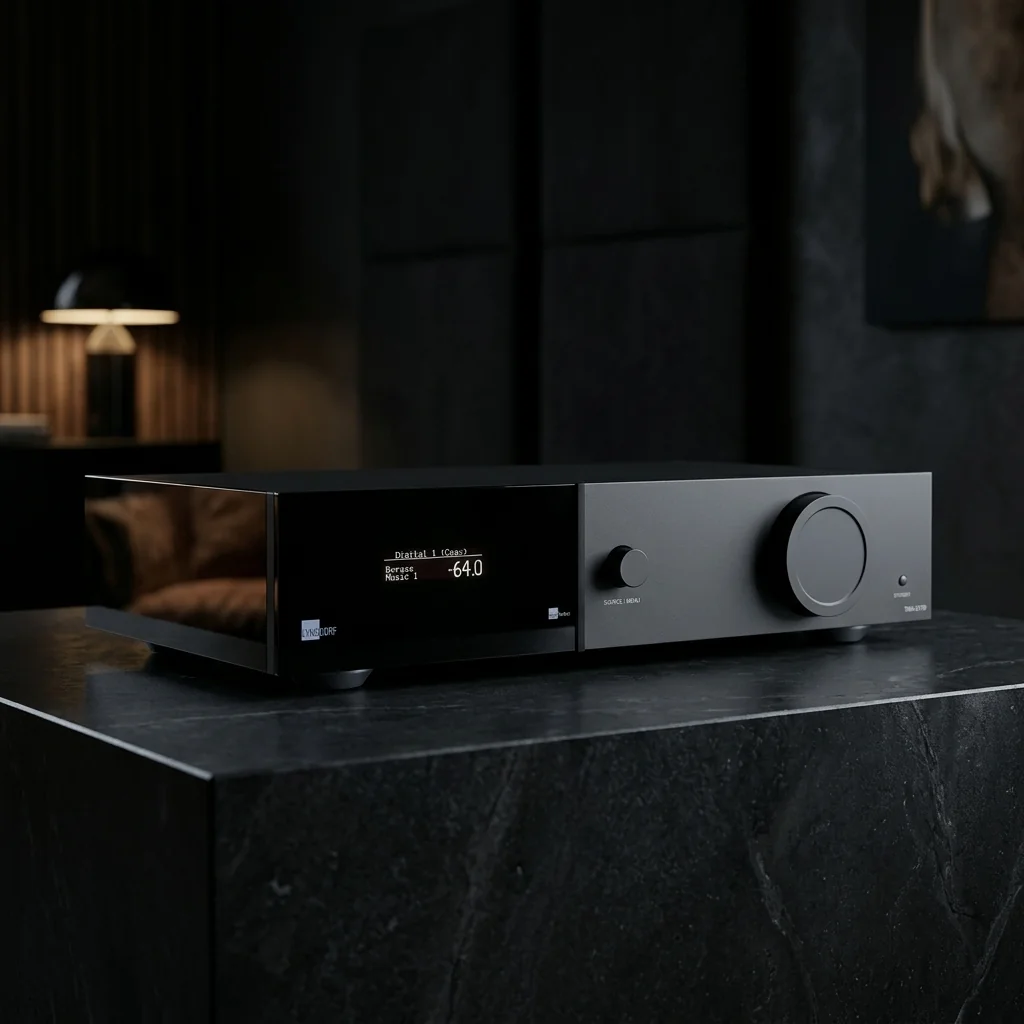
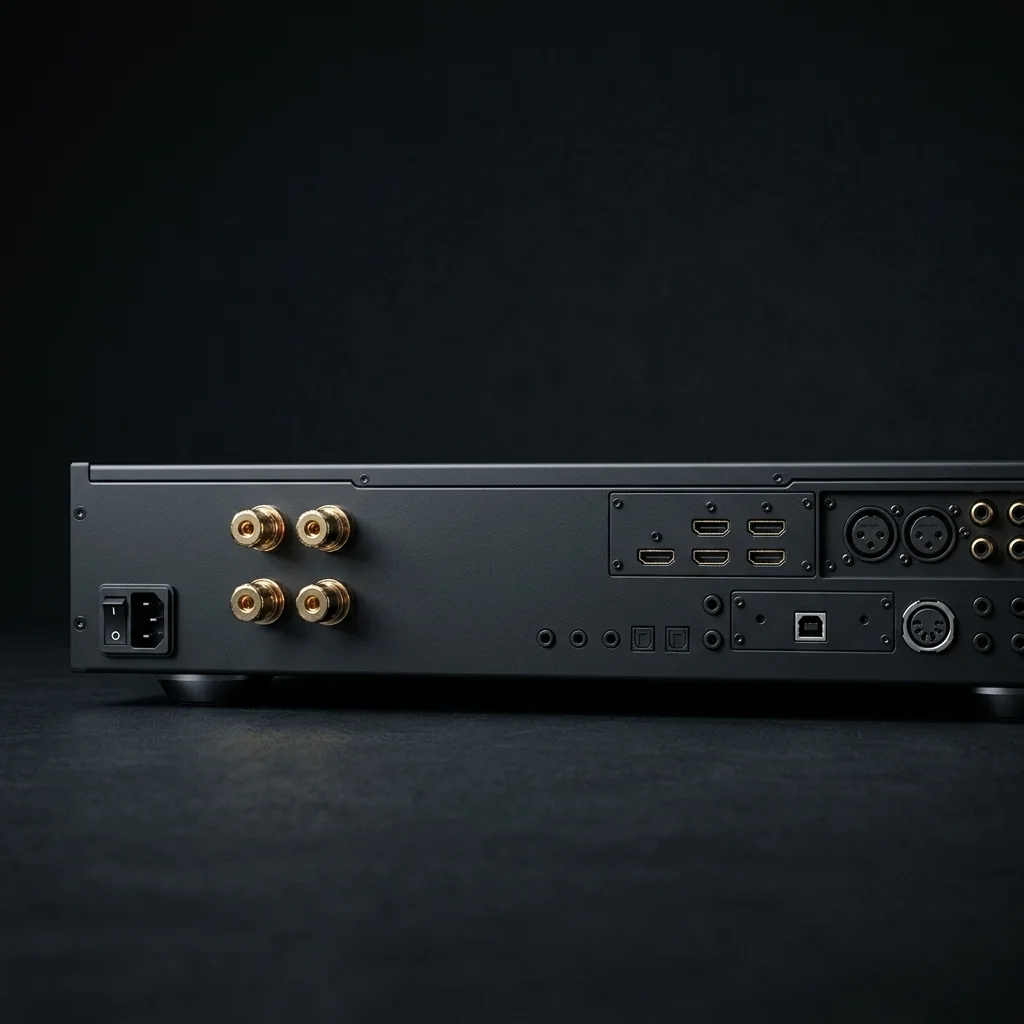
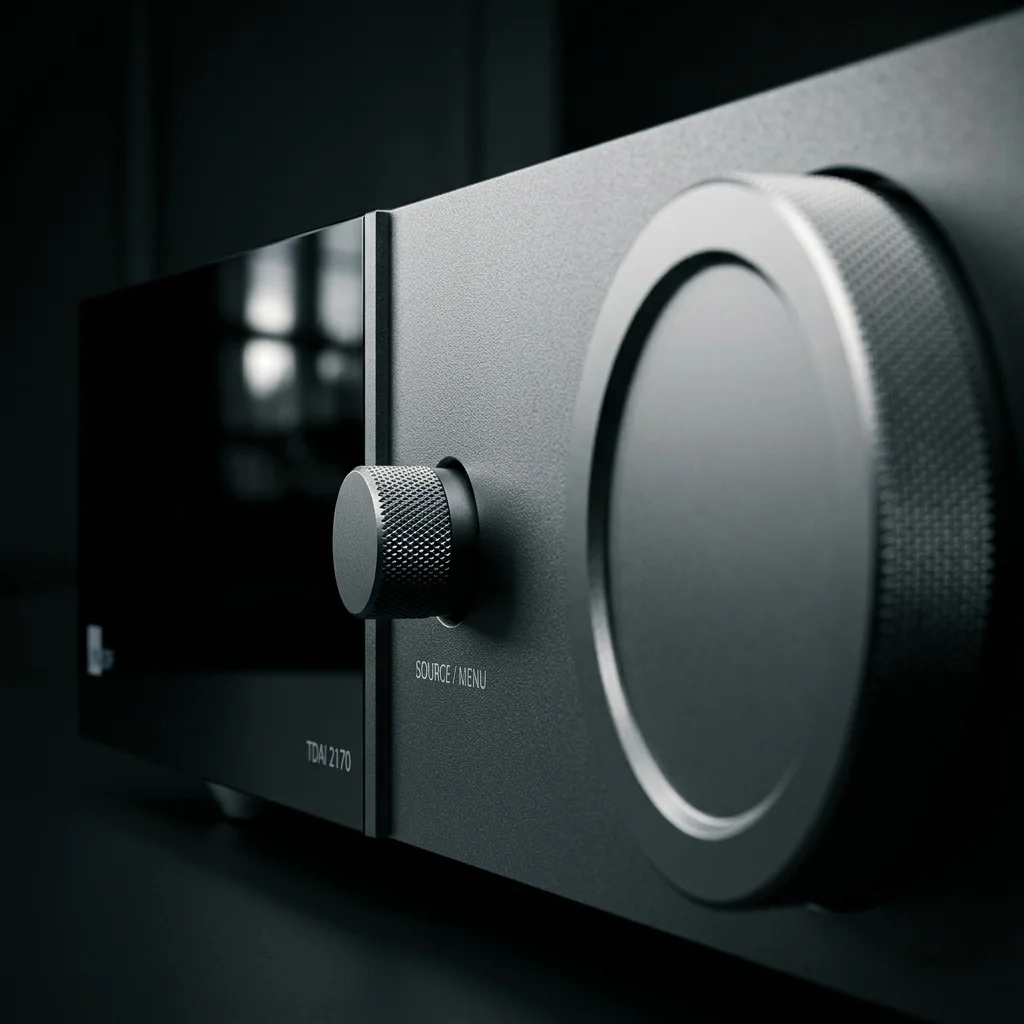
On paper the 2170 looks deceptively conventional — a low, wide, anodised-aluminium chassis measuring 10 × 45 × 36 cm and weighing 8 kg, with a precision-knurled volume wheel on the right, an OLED-style display in the centre and the Lyngdorf logo on the left. The official specification lists 2 × 170 W into 4 Ω, a peak current of 30 A, 0.02 % THD+N at 1 W into 4 Ω and a frequency response held within ±0.5 dB from 20 Hz to 20 kHz. Inputs in the base configuration are two coaxial S/PDIF (up to 192 kHz / 24 bit), four Toslink optical (up to 96 kHz / 24 bit), and two single-ended RCA pairs that are digitised inside the unit rather than handled in the analogue domain. Outputs are kept lean: a single S/PDIF coaxial pass-through, an analogue RCA pre-out routed through the digital volume control, trigger I/O and an RJ12 control connector. There is no Wi-Fi, no Ethernet, no Bluetooth, no AirPlay. The remote is infrared and requires line of sight, a small irritation that returns regularly in owner threads.
The modular slots transform this baseline into very different machines. The HDMI 4K Module brings three inputs and a single output, supports HDMI 2.0b, CEC and ARC, and accepts PCM up to 192 kHz / 24 bit. The USB Audio Module raises the resolution ceiling to 384 kHz / 32 bit PCM with DXD and DSD64/128 support. The Analog HD Module adds an MM phono stage, three additional line-level inputs and adjustable gain up to 24 dB. Reviewers who praise the 2170 for "doing everything" usually had at least two of those cards installed. A reader looking at a used listing should treat the bare model number as incomplete information until the configuration is clarified.
The Equibit signal path
The most consequential decision in the 2170 is what the chassis does not contain. There is no traditional DAC and no analogue preamp. PCM enters the input, the SHARC DSP from Analog Devices applies volume, RoomPerfect filters, ICC and any active Voicings, the result is converted directly into a pulse-width-modulated signal, that PWM signal is amplified by a Class-D output stage and only a passive LC filter sits between the silicon and the speaker terminals. This is the descendant of the TacT Millennium from 1999 — the world's first commercial fully digital amplifier, funded directly by Peter Lyngdorf and now in its fourth generation of refinement.
Two practical consequences follow. The first is that the volume control is performed in the digital domain in 0.1 dB steps, with the power supply itself acting as the regulating element across the top 24 dB of the range before the DSP starts attenuating bits. Owners on the Audio Science Review thread describe the result as "the quietest amplifier I have ever encountered, without any spuriae, glitches or pops". The second is that there is no global negative feedback loop around the output stage, a point flagged by the Polish review at avtest.pl. The textbook trade-off is higher theoretical distortion but freedom from the time-domain artefacts that feedback can introduce. Whether that matters audibly depends on the listener and the loudspeaker.
Inside the box, the most under-celebrated piece of hardware is the calibration microphone. As avtest.pl notes, it is a genuine measurement-grade capsule mounted on a metal tripod — equipment that would cost roughly 1 000 PLN on its own and that other manufacturers typically substitute with a plastic dongle. The presence of that hardware is the clearest signal of where Lyngdorf places RoomPerfect in the value hierarchy of the product.
A note on independent measurements
The 2170 has never been subjected to a Stereophile bench test or a full Audio Science Review measurement suite. The numbers that exist outside the manufacturer are the HomeTheaterHifi.com bench, repeatedly cited by the community although the original page is now intermittently unavailable, and the qualitative comments from the Polish lab review. This is a gap to declare openly: every claim about distortion, channel separation and noise floor in the analysis below ultimately traces back either to the manufacturer's data sheet or to second-hand citations of those measurements. The amplifier's reputation rests on listener convergence, not on a single published test report.
| Parameter | Value |
|---|---|
| Output power | 2 × 170 W into 4 Ω |
| Peak current | 30 A |
| THD+N | 0.02 % at 1 W into 4 Ω |
| Frequency response | 20 Hz – 20 kHz ±0.5 dB |
| Digital inputs (base) | 2 × coaxial (192/24), 4 × Toslink (96/24) |
| Analogue inputs (base) | 2 × RCA, internally digitised |
| Optional modules | HDMI 4K, USB HD (384/32, DSD), Analog HD (MM phono + line) |
| Outputs | 1 × coax S/PDIF, 1 × analogue RCA pre-out, trigger, RJ12 |
| Streaming | None native |
| Dimensions | 10 × 45 × 36 cm |
| Weight | 8 kg |
What reviewers say
The professional consensus on the 2170 is unusually tight on the descriptive level and unusually divided on the evaluative level. Almost every reviewer reaches for the same vocabulary — "neutral", "transparent", "dead silent", "three-dimensional" — and almost every reviewer ends up in a slightly different place when the time comes to score that vocabulary against listener preference. The 2023 long-term review at AudioResurgence, written eight years after launch, offers the cleanest summary of the converged opinion: "deep and wide soundstage, tight and focused" imaging, "extended and taut" bass, and a refusal to sound clinical despite an architecture that, by all rights, ought to. The same reviewer notes that the only way the 2170 starts to make full sense is "if you use it for everything" — DAC, preamp, room correction and, where the loudspeakers allow, the active crossover that replaces the passive network inside the cabinet.
Tonal balance and timbre
Reviewers converge on the 2170 as one of the most tonally neutral integrated amplifiers in its price band. Home Theater Review describes a sound "so clean, so neutral, so devoid of any sonic signature, it disappears completely". The Son-Vidéo blog reaches a more lyrical formulation — "a tasteful, well-balanced delivery between softness and dynamism with outstanding tranquillity" — but reports the same underlying observation. The Polish review at avtest.pl describes that same neutrality in less flattering language, calling the unprocessed sound "well-behaved, smoothed out, slightly desaturated" with a midrange that "lacks energy and spark". This is not contradiction. It is the same fact filtered through a different aesthetic framework: where some reviewers hear absence of colour as a virtue, others hear absence of character as a cost. The 2170's design treats the first reading as definitive, and the analysis that follows respects that — while keeping the second reading visible.
Dynamics and bass control
Several reviewers single out an unusual dynamic envelope at low volumes. Home Theater Review explicitly credits the power-supply-as-volume-control architecture for keeping the music alive when played softly — an effect that owners of conventional resistor-ladder amplifiers tend to report only at concert level. Bass is described as "tight and focused" and "extended and taut" by AudioResurgence, with the 30-amp peak current rating delivering reserves that none of the consulted reviews managed to exhaust. The dissenting note again comes from avtest.pl, which calls the bass "soft and warm rather than the precision typical of Class-D" — but only with RoomPerfect disabled. Once the calibration engages, every reviewer agrees that bass control snaps into focus.
Soundstage and resolution
The 2170 produces a soundstage that reviewers describe as wide, deep and three-dimensional, with imaging that sharpens further when RoomPerfect's Focus mode is selected. StereoLife, testing with Focal Electra 1008 Be2 over a coaxial digital connection, reports that Focus mode shifts vocals slightly in front of the speaker line and deepens the perspective, while Global mode opens the space laterally and improves instrument separation. Resolution is consistently rated as analytical without being mean — the ICC algorithm takes the edge off intersample peaks that would otherwise harden cymbals and brass on poorly mastered material.
Transparency and what it does not fix
Every reviewer in the corpus eventually circles back to the same caveat: the 2170 reveals what is in front of it. Spotify on a casual playlist remains, audibly, Spotify. The Son-Vidéo review reminds readers of Lyngdorf's own talking point that roughly seventy per cent of what a listener hears is room reflection rather than direct speaker output — RoomPerfect addresses that seventy per cent decisively, but it has nothing to say about a compressed master. The 2170 is a tool that strips the room out of the equation, not a forgiveness engine for the recording.
Methodological note on the split
The single most important pattern in the review corpus is that English-language reviewers tested the 2170 with RoomPerfect engaged and treated the calibrated state as the product. Some Polish coverage, avtest.pl in particular, spends considerably more time on the unprocessed sound and arrives at a colder verdict for that mode. Both approaches are legitimate. They simply answer different questions — "what is this amplifier like as a product?" versus "what is this amplifier like as a Class-D engine?" — and the gap between those answers is the cleanest summary of why the 2170 attracts strong opinion in either direction.
Voice of the community
Owner discussion of the 2170 is unusually evenly spread across forums — the dedicated AVS Forum owners thread, the AVForums "very happy" thread, the Audiogon Anthem-versus-Lyngdorf discussion, the Audiogon upgrade-to-3400 thread, the What Hi-Fi? opinions thread, Pink Fish Media, the Roon Labs Community thread, the Audio Science Review thread and the lone Polish discussion on audiostereo.pl. Read together, those threads tell a fairly stable story.
Praise clusters around four recurring observations. The first is the silence of the noise floor — "inky black background" appears so often that it functions as a kind of community shibboleth. The second is the practical, almost tactile change RoomPerfect produces in difficult rooms, where owners describe placing the speakers against the wall, running the calibration, and discovering that the bass problems they had been chasing for years simply evaporate. The third is build quality and the seriousness of the accessories — the measurement microphone, the metal tripod, the firmware that genuinely receives updates. The fourth is compatibility with electrically demanding loudspeakers: planars and electrostatics, especially Magnepan and Quad ESL panels, recur as success stories, with owners pointing to the 30-amp peak current rating and the stable behaviour under reactive loads.
Criticism is steadier and quieter, but consistent. The infrared remote requires line of sight and frustrates anyone using a rack with a glass door. The 0.1 dB volume steps feel deliberate to the point of slowness on the first day of ownership and stop mattering after the first week. The absence of native streaming is the most contested point in 2026 — for some owners, an external Bluesound or Roon endpoint is a non-issue; for others, it is the reason the 2170 cannot be their primary device. The 24-hour warm-up period after a power cycle is mentioned often enough to be considered a documented behaviour rather than folklore.
Long-term owners are remarkably stable. The Audiogon thread on whether to step up to the 3400 reads more like a justification exercise than a complaint about the 2170 — most posters who upgrade do so for the extra power, the second-generation DSP and the improved modules, not because the 2170 has stopped delivering. The audiostereo.pl thread is sparser in volume than the international forums but lines up with the same conclusion: the 2170 works if its owner accepts the RoomPerfect-centric philosophy.
Lifecycle and reliability
The 2170 left the production line around 2018, when the TDAI-3400 took its place at the top of Lyngdorf's integrated range — and the 3400 itself was retired on 25 September 2025. That two-stage exit raises an obvious question for a 2026 buyer: how durable is the support? The available evidence is reassuring. Lyngdorf continued to ship firmware updates for the 3400 throughout 2025, and the company's history of long-tail support for the TDAI-2200 — its predecessor in the same product line — suggests that older units are not abandoned the moment the next generation ships.
The real long-tail risk is modular. The HDMI 4K module is locked to HDMI 2.0b, which is fine for 1080p stereo audio extraction but increasingly awkward for 4K HDR sources expecting HDMI 2.1. The Analog HD module is an essential upgrade for vinyl owners but commands a premium on the secondary market because units sold without it cannot be retro-fitted easily. Used pricing on aggregator sites such as HifiShark and Polish retailers like audiostyl.pl settles broadly in the 6 000 – 11 000 PLN range, with the spread driven almost entirely by which modules are installed and what condition the calibration microphone is in. The 2170 retains value unusually well for a discontinued Class-D amplifier — a quiet endorsement of the architecture's longevity.
The two radars
The two radars trace the same shape from different angles, and the shape is the point. On the Sound Radar the 2170 sits as a high-tonal, high-resolution amplifier whose centre of gravity is at the analytical end of the chart — the long axes are tonal balance, resolution, dynamics and value, while timbre and midrange sit a step lower, faithful to the design philosophy rather than to any classical notion of organic colour. On the Acoustic Radar the 2170 reads as a transparent device that disappears at low and high listening levels alike, but asks a great deal of the rest of the system in return.
For the Sound Radar: Tonal balance is exemplary — a textbook neutral integrated. Bass is taut and deep with RoomPerfect engaged, softer without it. Mid is honest rather than projected — vocals sit in their recorded place, never pushed forward. Treble is open and resolving, kept just out of brightness by the Intersample Clipping Correction. Dynamics are unusual for the price, with the power-supply-as-volume design preserving micro-detail at low levels. Soundstage is wide and deep, sharpened by RoomPerfect's Focus mode. Resolution is analytical without becoming clinical. Timbre is the trait that splits opinion — natural in the sense of "uncoloured", but lacking the wooden bloom that listeners with tube backgrounds expect. Value is exceptional on the secondary market, with the modular architecture meaning the price scales with the configuration.
For the Acoustic Radar: Quiet listening is a genuine strength, helped by the supply-side volume control. Loud listening is stable and clean within the 170 W envelope. Transparency is the highest value on either radar — the design is built around the idea of the amplifier disappearing. Listening fatigue is low for buyers who prize neutrality and moderate for those who hear absence of colour as fatigue in itself. Application demands are the most demanding axis — not because the amplifier needs much current, but because it asks the room, the loudspeakers, the source and the listener's expectations to align with its philosophy. Tolerance for poor recordings is middling — ICC and RoomPerfect address electrical and acoustic problems, but neither rescues a compressed master.
Read together, the two radars describe an amplifier built around a single, deliberate trade: maximum transparency for maximum systemic discipline. Almost every reservation the reviews surface is a consequence of that trade — not a flaw in the execution.
Who it especially fits
The 2170 attracts a small number of clearly identifiable buyer profiles, and is honest enough as a product to push the wrong ones away quickly. Four profiles emerge from the reviews and forum threads.
The listener with a difficult room. Open-plan living spaces, large glazed walls, asymmetric placements, hard tile floors — every situation where conventional acoustic treatment is impractical or socially unacceptable. RoomPerfect's 3D mapping and adaptive target curve, validated repeatedly by AudioResurgence and the AVS Forum owners thread, turn rooms that had been written off into usable listening spaces. This is the canonical fit and the reason the 2170 exists in this shape.
The system builder with electrically demanding loudspeakers. Magnepan planars, Quad electrostatics, and other reactive loads where the amplifier needs both current reserves and tolerance of unusual impedance curves. The 170 W into 4 Ω rating, the 30 A peak current, and the absence of global feedback combine to handle these loads gracefully. Pre-out plus digital crossover also makes the 2170 a serious tool for active configurations — owners on Audiogon describe replacing the passive crossover inside their speakers with the unit's internal DSP to genuinely transformative effect. The conditional is acceptance of the neutral signature.
The migrant from Naim, Hegel, or a tube integrated. Listeners who have spent years inside a particular tonal aesthetic and now want to hear the recording itself, not the amplifier's translation of it. The 2170 is therapy for that listener — but the therapy is real, and the loss of the familiar warmth is not always welcomed. The What Hi-Fi? thread contains several stories of buyers who arrived from Naim, fell in love with the precision and then quietly missed the soul. This is a conditional fit: it works only if the buyer has genuinely outgrown coloured presentation, not if they think they should.
The minimalist who wants one box on the rack. A serious caveat applies here. Without an external streamer — a Bluesound Node, a Roon endpoint, a Cambridge MXN10 — the 2170 is not a single-box system in 2026. With one, it absolutely is. The fit depends on whether the buyer treats the streamer as part of the box or as a separate concern.
Three profiles fit poorly. Listeners who treasure tube warmth or Naim's particular musicality should look elsewhere. Listeners in small, acoustically clean rooms leave too much of the design philosophy unused. And buyers who demand native streaming with no peripheral required should consider Lyngdorf's own TDAI-1120 or the alternatives discussed in the next section.
Market positioning and real alternatives
The 2170 occupies a deliberately awkward slot. At launch it competed against integrated amplifiers that prioritised either pure sonics or a particular feature set; in 2026 it competes against a used market that includes its own successors. Three alternatives capture the philosophical range a 2170 shopper is likely to consider.
The NAD Masters M33 is the closest spiritual rival. It also marries Class-D, room correction and a modular philosophy, but each decision goes the other way. The amplification is Purifi Eigentakt, with publicly available bench measurements that the 2170 cannot match. Room correction is Dirac Live on a subscription model that unlocks full-range correction at additional cost — a different aesthetic philosophy from RoomPerfect's adaptive 3D mapping. Streaming is native BluOS, which removes the need for an external endpoint and makes the M33 the more obvious choice for a buyer who insists on a true single-box system. The trade is real: the M33 buys streaming convenience and measurement transparency at the cost of RoomPerfect's deeper acoustic modelling.
The Anthem STR Integrated approaches the same problem from the opposite end. It is a Class-AB design with an analogue gain stage, a flexible MM/MC phono input in the base configuration, and ARC Genesis room correction — a serious system in its own right, though one that targets pre-defined curves rather than acoustic maps. Owners on the Audiogon thread directly comparing the two describe the Anthem as warmer, more "amplifier-shaped", and more obviously sympathetic to vinyl. The Anthem is the choice for buyers who want their integrated to retain a recognisable Class-AB personality alongside the room-correction toolkit.
The Devialet Expert Pro 220 / 250 represents the third path — and the most expensive one. Devialet's hybrid analogue-digital ADH topology and the Speaker Active Matching system address the same end goal, system transparency, from the speaker-matching direction rather than the room-matching direction. The 2023 AudioResurgence review explicitly compares the two and finds the Devialet "harsh and quite clinical" against the Lyngdorf — a minority view among Devialet owners but a meaningful data point. The Devialet is the option for listeners who believe that speaker-amplifier coupling, not room correction, is where the real fidelity lives.
Lyngdorf TDAI-2170 versus NAD Masters M33
The single most relevant head-to-head is with the M33 — both are the canonical "Class-D with DSP" choices in this price band, and both are recommended in the same SoundStage feedback column for buyers who want a single integrated to replace separates.
Choose the Lyngdorf if: the room is unusual, planar or electrostatic loudspeakers are part of the plan, the active-crossover option is interesting, an external Roon endpoint is acceptable, and the 3D acoustic mapping of RoomPerfect seems philosophically richer than a Dirac target curve.
Choose the NAD if: native BluOS streaming is non-negotiable, publicly available Purifi measurements matter, manufacturer warranty on a new unit is a hard requirement, and the loudspeakers are conventional dynamic designs that do not stress the amplifier.
Pricing in 2026 reflects different markets. The 2170 is secondary-only, typically in the 6 000 – 11 000 PLN range depending on modules and microphone condition, with no warranty cushion. The M33 is still in production at around $4 999 / 22 000 PLN new, with full manufacturer support. The Lyngdorf wins on price and on the depth of its acoustic toolkit. The NAD wins on convenience, support and measurement transparency. There is no overall winner — only a clearer picture of which philosophy is being bought.
Version line
The 2170 belongs to a long, deliberate product line that traces back further than its model number suggests.
| Model | Years | Position | Launch reference |
|---|---|---|---|
| TacT Millennium I–IV | 1999 – 2003 | World's first commercial fully digital amplifier (Equibit) | precursor product |
| Lyngdorf TDAI-2200 | 2007 – ~2014 | First Lyngdorf-branded TDAI | ~£2 600 |
| Lyngdorf TDAI-2170 | ~2015 – ~2018 | Mid-tier digital integrated with RoomPerfect | £2 800 (base), £3 995 fully loaded |
| Lyngdorf TDAI-3400 | 2018 – 2025 | Flagship integrated, 2× power, 2nd-gen DSP | $6 499 |
| Lyngdorf TDAI-1120 | 2020 – present | Compact integrated with native streaming | $3 499 |
The arc is consistent. Peter Lyngdorf founded TacT Audio in 1999 to build the first commercial digital amplifier, spent a decade refining the topology, launched Lyngdorf Audio in 2005, introduced RoomPerfect as a co-founding feature, and has iterated the TDAI integrated line steadily ever since. The 2170 is not the start of anything and not the end of anything — it is the moment the line found the cleanest expression of its mid-tier ambition.
Should a 2026 buyer hunt the predecessor on the used market? The TDAI-2200 is genuinely cheaper and shares much of the philosophy, but it lacks the SHARC-class DSP power needed for full RoomPerfect 3D mapping, and the optional modules are an older generation. Unless the price gap is severe, the 2170 is the right entry point.
Should the buyer step up to the 3400 or wait for the next Lyngdorf flagship? The 3400 was discontinued in September 2025, and Lyngdorf has not yet announced a direct successor in the same price slot — the company's recent focus has been on the smaller TDAI-1120 and the Steinway Lyngdorf range above. A patient buyer can wait, but the wait is not for an iteration of the 2170. The 2170 itself is already the patient choice — a product whose entire commercial story is visible, with no further surprises.
System synergy and room fit
The 2170's signature challenge is not powering the loudspeakers — that part is straightforward — but matching its philosophy to a system that lets the philosophy show. The relevant variables are all easier to discuss in concrete terms.
Driving difficulty. With 170 W into 4 Ω and 30 A peak current, the 2170 is comfortable with the vast majority of stand-mount and floor-standing designs. The architecture handles reactive loads gracefully — Magnepan 1.7i and 3.7i, Quad ESL 989, Audeze headphones via the pre-out, and reasonably efficient compact monitors such as Dynaudio Special 40, Focal Electra 1008 Be2 (the pairing tested by StereoLife) or the KEF R3 Meta all sit well within its envelope. The matching difficulty is philosophical: warm, romantic loudspeakers can leave the system sounding doubly recessed because the 2170 adds no compensating warmth of its own. The same StereoLife review explicitly flags the Audel CG Tower as a poor match for this reason.
Room size and placement. The 2170 finds its purpose in rooms between roughly 20 and 60 m² where acoustic compromises are real. In a small, well-treated dedicated listening room, RoomPerfect has less to do and the cost of the technology is partly wasted. The reverse is also true: in a 50 m² open-plan apartment with glazed walls, the 2170 is one of the few integrated amplifiers that can credibly turn the space into a serious listening environment without acoustic treatment.
Quiet listening. This is one of the 2170's most consistent strengths. The power-supply-as-volume topology — well documented on the Audio Science Review thread and described in Home Theater Review — preserves dynamic range at low volumes that conventional designs deliver only at concert level. Late-night listening sessions are a documented use case across owner threads.
Tolerance for poor recordings. Middle of the road. ICC takes the sting out of poorly mastered cymbals and brass, and RoomPerfect removes the room as a variable, but neither addresses what is on the recording itself. Spotify on the standard tier still sounds like Spotify on the standard tier — clean, but not flattered.
Long-session fatigue. Low for listeners who genuinely prefer neutrality, moderate for listeners whose ear keeps reaching for warmth that is not there. This is the trait that produces the slow-burn dissatisfaction occasionally reported in the Pink Fish Media and What Hi-Fi? threads — listeners who admire the precision for six months and then quietly move on.
Stress tests at the edges
At very low volumes the 2170 is, by reviewer consensus, one of the more capable integrated amplifiers in its price band — the result of designing volume control as a power-supply problem rather than a voltage-divider problem. At the loud end the 170 W envelope is more than adequate for the rooms and loudspeakers the 2170 is plausibly going to live with; no review in the corpus describes running out of headroom on the kinds of music a typical owner plays. Difficult impedance curves — large speakers that drop below 3 Ω in the midbass, planars with steep capacitive loads — are handled cleanly thanks to the absence of global feedback and the generous current reserve. The genuine edge case is heavily compressed material from the loudness-war era: ICC mitigates the worst of the intersample clipping, but it cannot undo dynamic range that the mastering engineer chose to throw away.
Recommended system configuration
- Source: a Roon endpoint connected through the USB HD module if installed, otherwise a Bluesound Node over coaxial S/PDIF, or a Cambridge Audio MXN10 for buyers who prefer a UPnP-only path.
- Loudspeakers: Magnepan 1.7i / 3.7i for planar enthusiasts; Focal Electra 1008 Be2 or Sopra 2 for buyers who want detail and dynamics; Dynaudio Special 40 for compact rooms; KEF R3 Meta for value-focused buyers; Quad ESL 989 for committed electrostatic listeners.
- Speaker cables: short, low-inductance designs. Class-D output filters interact with cable inductance, and the 2170's filter is sensitive enough to reward conservative cable choices.
- Subwoofer (optional): through the pre-out and the internal digital crossover. REL S/510 and KEF KC62 are sensible partners; the 2170's DSP timing alignment is genuinely useful here, more than in most subwoofer integrations.
Sources
- https://lyngdorf.steinwaylyngdorf.com/lyngdorf-tdai-2170/
- https://lyngdorf.steinwaylyngdorf.com/lyngdorf-tdai-3400/
- https://lyngdorf.steinwaylyngdorf.com/roomperfect/
- https://hometechnologyreview.com/lyngdorf-audio-tdai-2170-integrated-amplifier-reviewed/
- https://www.audioresurgence.com/2023/02/lyngdorf-tdai-2170-review.html
- https://www.avtest.pl/wzmacniacze/item/1011-lyngdorf-audio-tdai-2170
- https://bestofhighend.com/peter-lyngdorf-part-1/
- https://audiosciencereview.com/forum/index.php?threads/lyngdorf-2170.739/
- https://hometheaterhifi.com/reviews/amplifier/integrated-amplifiers/lyngdorf-audio-tdai-2170-fully-digital-integrated-amplifier-review/
- https://blog.son-video.com/en/2015/09/review-lyngdorf-tdai-2170-dac-and-hdmi-stereo-amplifier/