
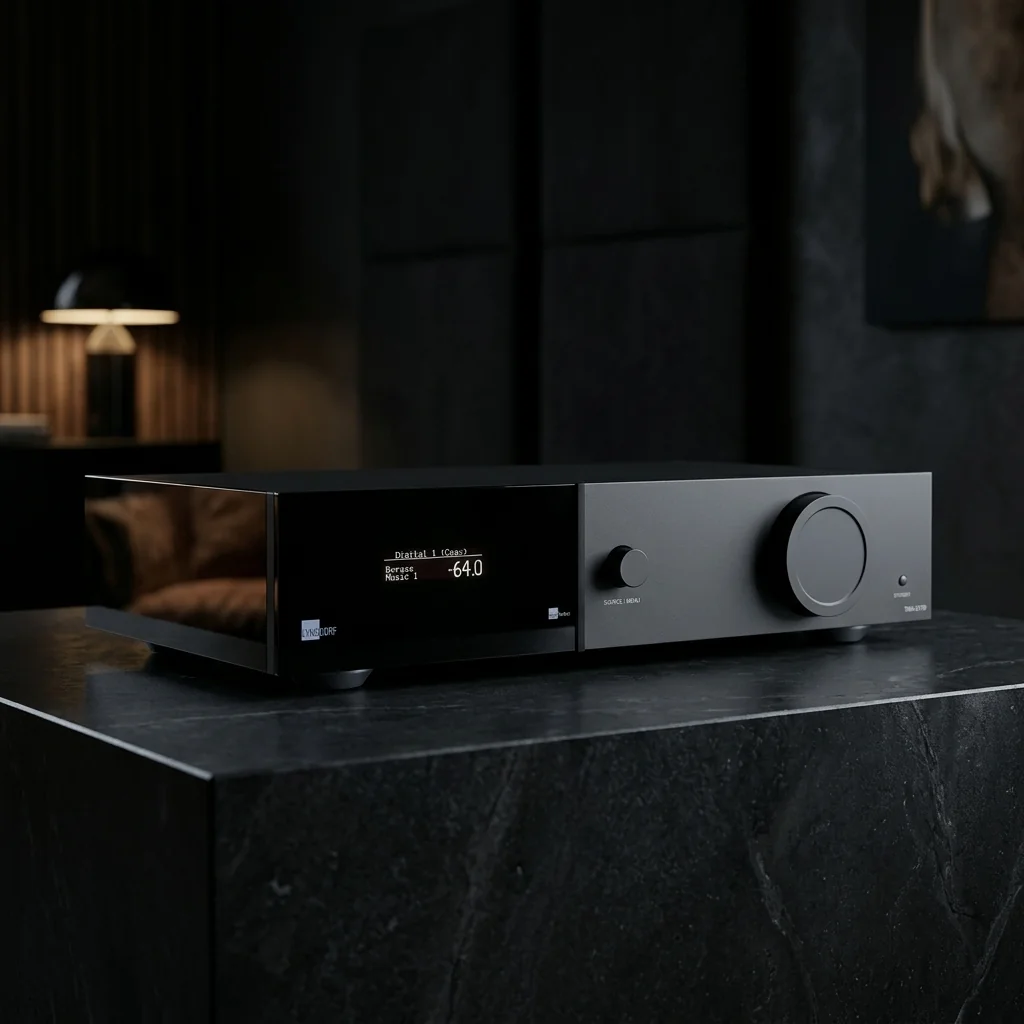
Lyngdorf TDAI-2170: sound character, construction, and the case for a fully digital integrated
Lyngdorf's mid-tier digital integrated amplifier was engineered to disappear from the system, with RoomPerfect built into the signal path rather than bolted on as a feature. Reviews converge on the same vocabulary — neutral, transparent, three-dimensional — and split sharply on whether that absence of colour is a virtue or a cost.
What defines it
The Lyngdorf TDAI-2170 is a fully digital integrated amplifier launched around 2015 and now living entirely on the used market. Four traits hold it together. The signal stays digital from the input through the SHARC DSP and the Class-D output stage all the way to the speaker terminals — there is no DAC, no analogue preamp. RoomPerfect, Lyngdorf's patented 3D acoustic mapping system, is built into the signal path as a peer component rather than a feature add-on. The chassis takes optional HDMI 4K, USB HD and Analog HD modules, so no two units are configured alike. And the design refuses to add a sonic signature of its own — the amplifier is engineered to disappear from the system.
For whom
The TDAI-2170 fits four buyer profiles. Listeners with difficult rooms — large glazed walls, open plans, asymmetric placements — where RoomPerfect's deeper acoustic modelling earns its keep. System builders with planar or electrostatic loudspeakers that need current reserves and a stable amplifier under reactive loads. Migrants from Naim, Hegel or tube integrated amplifiers who want to hear the recording rather than the amplifier — with the honest warning that the loss of familiar warmth is real. And minimalists who accept that "one box on the rack" needs an external streamer in 2026.
Strengths and reservations
Strongest assets: RoomPerfect as a serious 3D-mapping room-correction system; a fully digital signal path that lowers noise and removes one set of analogue compromises; modular I/O that scales the chassis to the use case.
Main reservations: no native streaming, so an external Roon endpoint or Bluesound is required; Polish coverage (avtest.pl) describes the unprocessed sound as well-behaved to the point of being emotionally underpowered; the product is discontinued and the modular cards depend on long-term manufacturer support.