
Rotel Michi X5 Series 1: flagship control, huge power, and a used-market reality check
The X5 Series 1 delivers 500 watts of controlled flagship drive with an onboard DAC and phono stage. On the used market it remains a credible all-in-one choice for anyone who needs real power without the Series 2 premium.
Rotel Michi X5 Series 1
Intro / Lead
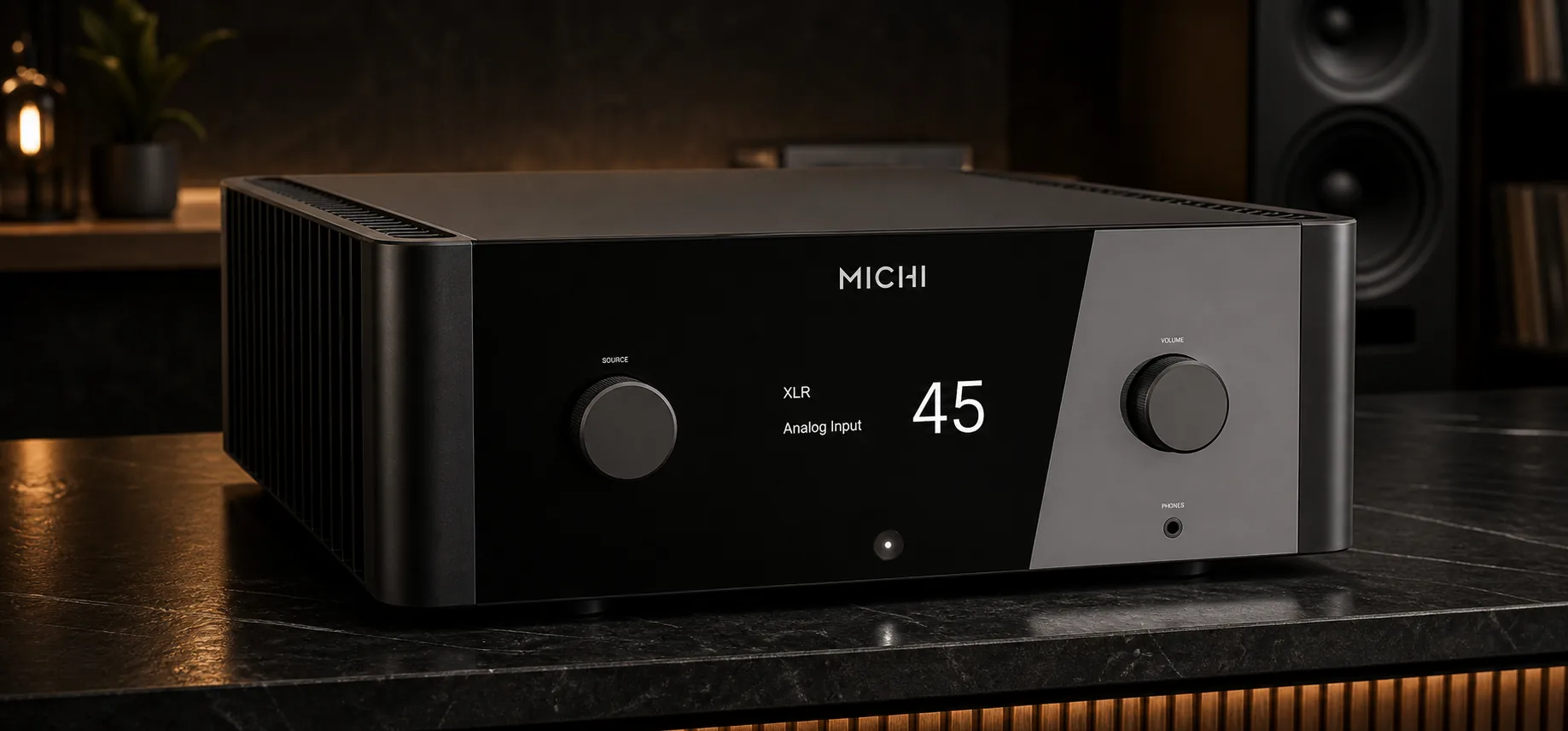
The original Rotel Michi X5, introduced on August 18, 2020, was one of those products that made an immediate visual statement and an equally immediate technical one. It arrived with 350W per channel into 8 ohms, 600W into 4 ohms, dual toroidal transformers, a premium AKM-based DAC, MM/MC phono, aptX Bluetooth, and a 43.8kg chassis that made it clear Rotel did not intend Michi to feel like a lightly dressed-up version of its mainstream range. On paper, it looked like a "super integrated" designed to eliminate excuses. The more interesting question, then and especially now, is whether the first X5 was merely over-specified or genuinely coherent.
The source base suggests that it was coherent. Professional reviewers consistently describe the X5 as highly controlled, spatially confident, powerful without sounding crude, and revealing in a way that places it closer to serious high-end separates than to convenience-led one-box solutions. Just as importantly, the original X5 is not generally treated as a soft-focus luxury amplifier. It is more often described as precise, grounded, and authoritative, with enough musical ease to avoid sterility but not enough intentional sweetness to flatter every system automatically.
That distinction matters more in 2026 than it did in 2021, because the first X5 now exists beside the X5 Series 2, launched on April 14, 2023. The newer model brought a revised DAC platform, a long list of component changes, and an obvious reason for buyers to wonder whether the original has been superseded in a way that makes it merely transitional. The answer is more nuanced than that. The first X5 is best understood not as the inferior draft before the polished revision, but as a fully formed integrated amplifier with a specific sonic and practical profile whose value now depends less on novelty and more on fit, condition, and used-market pricing.
This article is a synthesis of manufacturer information, professional reviews, independent measurements, community discussions, and used-market traces. It is not a first-hand listening report. Its purpose is to identify what the original Michi X5 consistently is, where the evidence is less conclusive, and what sort of buyer the Series 1 version still makes sense for.
Device DNA / constitutive traits
The first defining trait of the original X5 is authority without panic. Many powerful integrated amplifiers can sound impressive in short bursts because they project mass and control, but reviewers repeatedly suggest that the Michi X5's power reserve translates into composure rather than bluster. The amplifier is repeatedly framed as stable, unflustered, and able to maintain order under demanding loads.
The second trait is resolution-led control. This is not a classic warmth machine. It is generally described as organized, explicit, and highly informative. That does not automatically make it clinical. Several sources still hear body, depth, and scale. But the center of gravity is clearly on order, grip, and clarity rather than lushness.
The third trait is serious integration. The DAC, phono section, and input complement are not decorative. They form part of the reason the X5 made sense at launch and still makes sense now. Even where external alternatives can outperform the internal stages, the evidence suggests that Rotel did not treat those sections as afterthoughts.
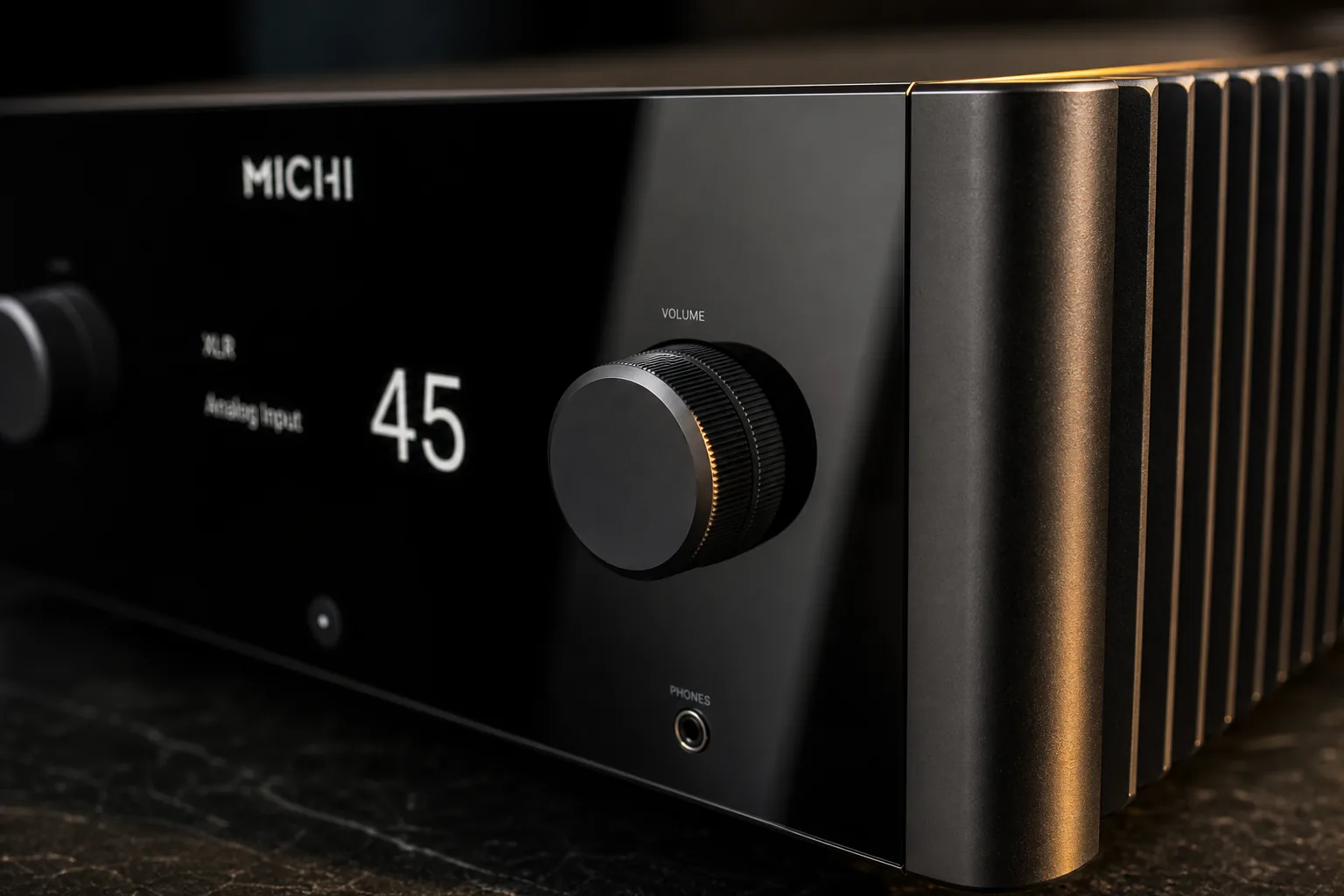
The fourth trait is flagship object presence. The large glass front, the oversized chassis, the substantial heatsinking, and the sheer mass of the unit matter because they reinforce what the audio circuit is trying to do. The original X5 was designed to feel like a premium object in the room, not just a technically capable amplifier hidden in a standard box.
Quick decision profile
Three strongest strengths:
- Huge dynamic reserve with real bass control and loudspeaker authority.
- Strong system completeness: DAC,
MM/MCphono, rich connectivity, and premium build in one chassis. - A presentation that combines precision and scale without reducing everything to brute force.
Three main caveats:
- It is not the safest choice for listeners who want an amplifier to sweeten every recording and every partner automatically.
- The
Series 1digital section is no longer modern by flagship standards onceSeries 2exists as reference context. - Used-market value depends heavily on condition and price discipline, because buyers at this level have real alternatives.
Who it is for and who it probably is not for:
The original X5 makes the most sense for a buyer who wants a very powerful, highly capable integrated amplifier with genuine high-end build quality and enough built-in functionality to keep a system elegant. It makes less sense for someone chasing overt tube-like romance, maximum future-proof digital ambition, or the lightest possible industrial footprint.
Build and technical specification
The original Michi X5 is a Class AB integrated amplifier rated by Rotel at 350Wpc into 8 ohms and 600Wpc into 4 ohms. Those figures are already striking, but the independent measurement story is what really matters. SoundStage!'s lab measured 390W into 8 ohms and 646W into 4 ohms at 1% THD+N, confirming that this is not a marketing-only powerhouse. The same measurements also suggest strong current delivery and stable high-output behavior under realistic dynamic stress.
Internally, the X5 uses dual in-house toroidal transformers and substantial energy storage, with multiple sources referring to 88,000uF of reservoir capacitance. SoundStage! also reports six pairs of matched Sanken output devices per channel and a MUSES72320 volume-control implementation. Whether or not a reader assigns audiophile significance to each individual part, the broader conclusion is simple: the first X5 was engineered like a flagship integrated, not like a midrange amplifier dressed in more expensive materials.
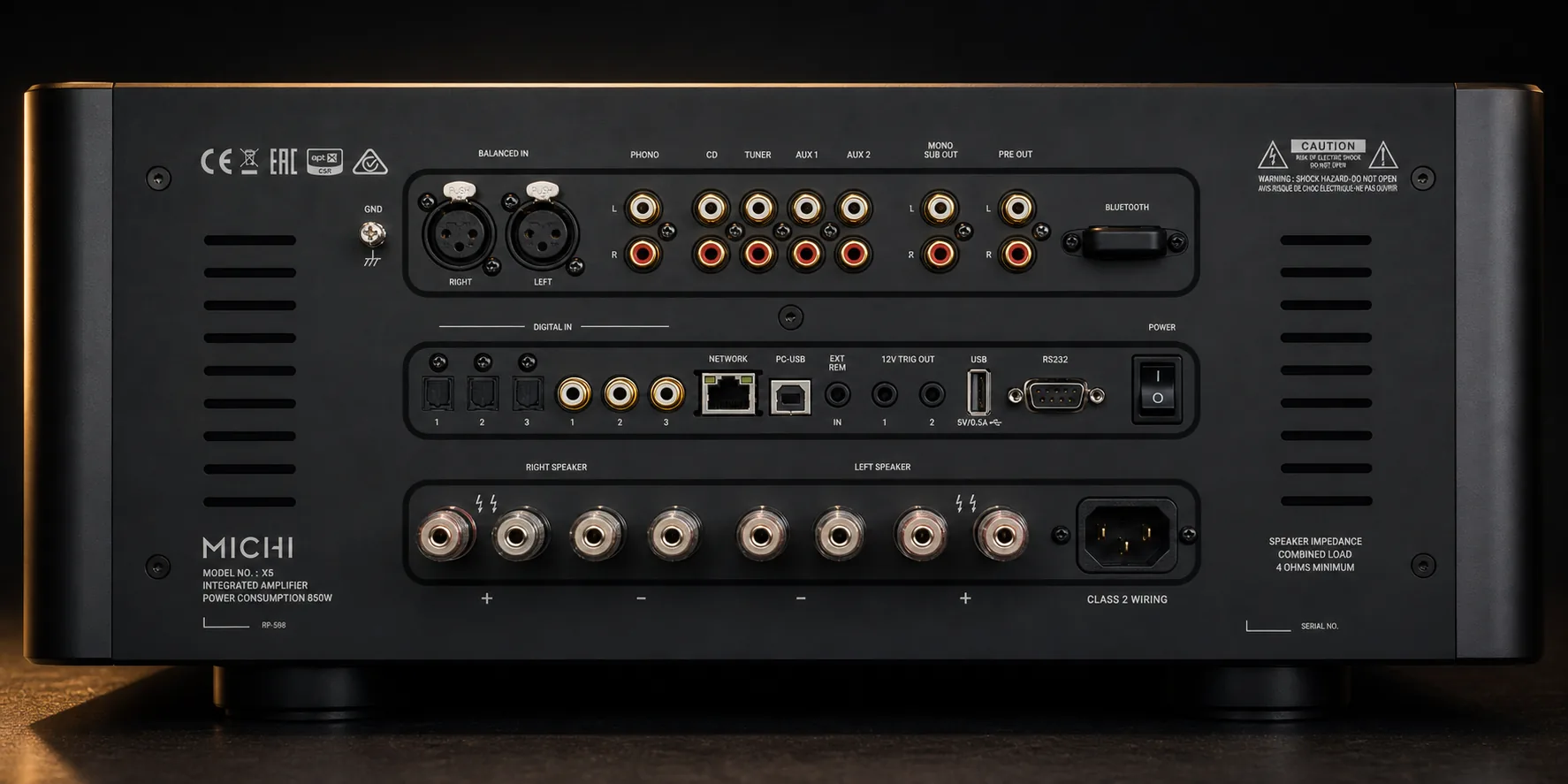
Connectivity is unusually comprehensive for a premium two-channel integrated of its era. The amplifier includes 4 x RCA line inputs, 1 x balanced XLR, 3 x coaxial, 3 x optical, PC-USB, Bluetooth with aptX, a selectable MM/MC phono stage, pre-outs, dual mono subwoofer outputs, and a front headphone output. It is one of those products that genuinely tries to be the center of an entire stereo system rather than simply the amplification stage.
The DAC in Series 1 is based on an AKM AK4495SEQ. Official specifications list USB support up to 32-bit/384kHz, coaxial and optical support up to 24-bit/192kHz, plus DSD, DoP, MQA, and Roon Tested compatibility. By contemporary standards that no longer feels exotic, but it still matters in context because the original X5 was launched as a complete hub, and the review evidence does not treat the DAC as embarrassingly secondary.
The phono section deserves similar attention. The X5 supports both MM and MC, which already separates it from many supposedly serious integrated amplifiers that offer either no phono at all or only a basic MM stage. SoundStage!'s measurements suggest the MM implementation is genuinely competent, with close RIAA adherence and stronger-than-quoted signal-to-noise performance. That does not automatically place it ahead of dedicated outboard phono stages, but it clearly reinforces the X5's intended completeness.
The physical object is part of the technical argument. At 43.8kg, the X5 is not a casual piece of electronics. It measures 485 x 195 x 452mm, uses a large front-panel display, heavy side heatsinking, and a distinctive black glass fascia. Reviewers repeatedly stress its mass, finish quality, and the sense that it behaves like a premium flagship product before a note is even played. That matters because, at this price level, build confidence is part of long-term ownership value.
One practical warning does emerge from the measurement side: this amplifier runs seriously warm when pushed. SoundStage!'s lab specifically notes that the side panels became uncomfortable to touch after a sustained high-output stress test. That does not imply a design flaw, but it does mean ventilation should be treated as a real setup issue rather than a formality.
Another practical point is that the original X5 was built in a period when manufacturers still treated source flexibility differently than they do now. It includes a genuinely generous spread of physical inputs, plus tone controls, balance adjustment, configurable display modes, and system integration features such as triggers, network control, and custom input naming. In other words, it behaves less like a stripped-back purist integrated and more like a flagship command center for a traditional hi-fi rack. For some buyers, that is a feature. For others, it can read as complexity. Either way, it is part of the product's personality and should be judged as such.
The headphone output is not the star of the story, but it is worth mentioning because its presence reinforces the X5's integrated identity. Independent measurements suggest it is usable rather than headline-worthy, which is exactly the kind of proportional judgment this product benefits from. Not every built-in function has to define the product, but several of them add enough practical value that the X5 is easier to justify as a whole-system purchase than many more minimalist rivals.
The original DAC platform also deserves to be placed in time correctly. When the X5 launched — as documented in the Rotel X5 product page and the early launch coverage from Darko.Audio and What Hi-Fi? — its AKM implementation, high-resolution USB support, and inclusion of MQA and Roon Tested compatibility made it feel properly upmarket. The reason this matters in 2026 is not to diminish it, but to frame it honestly. The internal digital side is still good enough to be usable and meaningful. It is simply no longer a leading-edge reason on its own to choose Series 1, especially after the Michi Series 2 launch.
What reviewers say
The single strongest reviewer consensus concerns control. SoundStage! Hi-Fi (Roger Kanno) hears the X5 as both powerful and composed, with a presentation that avoids the crude or overbearing tendencies that some listeners associate with high-output solid-state integrated amplifiers. Instead of sounding like a battering ram, it is presented as an amplifier that keeps complex music ordered and confident, even when the system asks for large dynamic swings.
StereoNET (David Price) reaches a related conclusion from a slightly different angle. There, the X5 is described as something of a "grower": not instantly charming in the way a romantic tube amp or a sweeter-voiced transistor integrated can be, but increasingly impressive over time because of its insight, scale, image stability, and command of the recording. That is a useful distinction. It suggests the X5 may not make its strongest case in a short, showroom-style first impression unless the listener is already primed for its sort of truth-telling presentation.
Hi-Fi News (Andrew Everard / Paul Miller) contributes an especially valuable nuance by suggesting that the X5 is not simply a bigger X3. In both technical and sonic terms, it appears to have its own fingerprint. The magazine's coverage points toward a somewhat darker, moodier, or weightier balance relative to the smaller model, even while preserving the broader Michi ambition of low distortion, very high control, and serious drive capability. This helps explain why some listeners hear the X5 as richer and fuller, while others experience it primarily as a high-resolution control machine.
HiFi Chicken (Anton), meanwhile, makes the strongest case for the amplifier's refusal to become thin. That review emphasizes detail, openness, and stage scale, but also goes out of its way to say that the X5 does not buy those virtues by stripping body or life from the music. That matters because the fear around very powerful solid-state integrateds is often not that they will be weak, but that they will be technically impressive and emotionally dry. The original X5 does not seem to fit that stereotype cleanly.
The internal DAC receives more respect from reviewers than many all-in-one flagship implementations do. HiFi Chicken suggests that it compares more seriously with external alternatives than expected, and the SoundStage! measurements plus the HiFi Choice review and the Stereoindex coverage by Bryan Schmidt confirm that Rotel at least gave the section real design attention. None of this means a demanding digital specialist must use the internal DAC in 2026. It does mean the first X5 is not reduced to "great amplifier, throw away the digital board."
The same is broadly true of the phono section. Review commentary and measurement support both indicate that the X5's MM/MC capability is real value rather than checkbox theater. For vinyl listeners who want a premium integrated without instantly adding outboard stages, that remains a meaningful ownership advantage.
What reviewers do not consistently say is just as important. They do not generally frame the original X5 as especially forgiving, especially lush, or especially beautifying. Nor do they portray it as a bright or brittle amplifier in the simplistic sense. The best synthesis is that it is revealing, powerful, and structurally disciplined. If it sounds dry or relentless in a given system, the cause is at least as likely to be system context as intrinsic tonal aggression from the amplifier itself.
It is also striking how often reviewers return to the word "respect" in one form or another, even when they are not describing emotional intimacy in explicitly romantic terms. That matters because it suggests a product whose appeal is built on accumulated confidence rather than on one spectacular trick. The original X5 does not appear to win by spotlighting a single frequency range or by seducing the listener with exaggerated sweetness. It wins by sounding complete, stable, and unembarrassed under scrutiny.
The difference between that and plain neutrality is important. Neutrality as a marketing term can mean almost anything. In the original X5's case, the more reliable reading is that it has enough tonal density and enough dynamic grip to avoid sounding threadbare, but not enough editorial warmth to blur distinctions. That is why some reviewers hear weight and ease while still describing the amplifier as highly informative. It is not neutral in the sense of being emotionally absent. It is neutral in the sense of refusing to homogenize music.
Community voice
The owner/community layer around the original X5 is thinner than the professional review base, but it still adds useful real-world texture. In the AVForums Rotel Michi X5 thread, one listener describes hearing a degree of clarity that felt unusually obvious, along with an impression of cohesion and, relative to the X3, extra depth and warmth. Another practical point in that thread is less glamorous but equally relevant: this is a physically massive amplifier that demands planning. The sheer weight and size are not abstract numbers once the unit enters a home.
Roon community traces help in a different way. They show the X5 being treated as a serious USB-connected endpoint for high-quality playback rather than as a token convenience amplifier. That is not a sound-quality verdict by itself, but it does support the broader reading that owners see the internal digital side as credible enough to live with in a resolved system.
Used-market traces — including the Audiogon listing from April 2022 and the HifiShark model page — bring the buying context into focus. Listings and aggregations visible around 2025-2026 suggest that Series 1 commonly appears around the mid-EUR 4,000s in parts of Europe and around USD 4,750 in at least one late-2025 U.S. trace, though actual sale outcomes, condition, local demand, voltage, and packaging all matter. The important point is not a single "true market price." The important point is that the original X5 still circulates as a desirable premium integrated rather than as an abandoned transitional product.
The community layer also indirectly reinforces a larger editorial conclusion: the original X5 is not mainly discussed as a problem to be fixed. Owners and shoppers talk about synergy, alternatives, and value, but there is no strong pattern of the amplifier being treated as structurally compromised or disappointing in core sonic terms. That supports the argument that Series 1 remains viable if the price and system context are right.
What the community layer does not strongly provide is a deep long-term reliability narrative specific to Series 1. That is not unusual at this level, especially for a product that sold in smaller numbers than mainstream integrated amplifiers, but it does matter. A buyer considering a used X5 should still think like a buyer of a large, heavy, premium electronic component: condition, service access, packaging, voltage version, and seller credibility matter almost as much as the model's original reputation.
This is where the market traces become more than trivia. An amplifier like the original X5 is expensive enough that "good deal" and "bad deal" are often determined not by the model name but by the exact specimen. A complete example with original box, remote, manual, and a transparent ownership story can justify stronger money than a rough or ambiguous listing. Because the first X5 is now part of the legacy-premium market rather than the current-product market, buyers should approach it with used-market discipline, not with launch-era halo thinking.
Two radars
The sound radar for the original Michi X5 lands high on macro dynamics, bass control, neutrality, and soundstage scale, while staying more moderate on warmth and poor recording tolerance. That matches the source base well. This is an amplifier that seems to thrive when asked to organize large musical events, maintain grip, and preserve image structure. It is less likely to turn rough material into comfort listening by sheer tonal generosity.
The usability radar is also strong. Functionality, system integration, phono quality, and build and finish are all clear strengths. The only reason digital flexibility does not score even higher is contextual: in isolation, the first X5 remains well-equipped, but in 2026 the existence of Series 2 and the wider market's evolution make the original digital platform feel less future-facing than it once did.
In plain language, the radar picture says this: the original X5 is a high-capability amplifier first and a convenience product second, even though it is unusually complete. It excels most where power, structure, and premium execution matter. It is less universal where a listener wants the amplifier itself to soften edges or where long-term digital platform freshness is a top buying criterion.
Another useful way to read the radars is this: the X5 does not ask the buyer to choose between seriousness and convenience, but it does ask the buyer to accept a specific flavor of seriousness. This is not the integrated for listeners who equate refinement with softness. It is the integrated for listeners who equate refinement with composure, order, and the ability to scale without strain.
Who it especially suits
The first X5 especially suits the listener who wants integrated simplicity without integrated-level compromise. That buyer likely has loudspeakers that benefit from power reserve and control, values stable imaging and low-frequency grip, and would prefer not to build a system out of multiple separate boxes unless those boxes produce a clearly superior result.
It also suits the buyer who wants completeness without sliding into lifestyle audio vagueness. The original X5 offers meaningful analog and digital input flexibility, a credible phono stage, and enough built-in infrastructure to anchor a serious system cleanly. For someone who wants one elegant premium amplifier to do most things well, it remains compelling.
It is less ideal for listeners whose first priority is softness, bloom, or a sense of tonal generosity independent of recording quality. The source base simply does not support reading the X5 as a universal sweetener. If the system is already lean, incisive, or aggressive, the amplifier is more likely to reveal that than to heal it.
It is also not the obvious choice for a buyer whose main excitement lies in the latest digital architecture. Series 2 exists, and so do several competing integrated amplifiers with newer digital ecosystems. The first X5 still makes sense, but more as a deeply capable amplifier with strong built-in support than as the final word in modern digital integration.
Three especially realistic buyer profiles emerge from the source base:
The first is the high-control all-in-one buyer: someone with ambitious floorstanders or difficult standmounts who wants a serious stereo centerpiece with minimal box count. For that person, the X5 makes a lot of sense because it replaces several potential decisions at once without reading like a compromise product.
The second is the used-premium upgrader: a buyer who is less interested in chasing the newest spec sheet and more interested in entering a higher level of build, drive capability, and ownership feel at a second-hand price. For that person, the first X5 can be a very rational move as long as the exact listing is sensible.
The third is the vinyl-plus-digital pragmatist: someone who listens to records, files, and perhaps USB-fed streaming from a computer or server, and wants one chassis to handle all of that at a high level. The X5 is unusually well-positioned for this kind of ownership because it offers enough analog and digital credibility to remain tidy without feeling cheapened by convenience.
Who is it not especially for? Not for the listener who treats amplifier ownership as a rolling sequence of flavor experiments. Not for the buyer who wants the smallest possible physical object. And not for the person whose listening priorities are dominated by the newest internal digital implementation rather than by amplifier quality as such.
Market positioning and real alternatives
The most immediate internal alternative is the Michi X3. For a buyer who likes the Michi design language and general engineering direction but does not need the X5's scale, weight, or more ambitious phono capability, the X3 remains the cleaner, lighter, and cheaper path. The source base strongly suggests, however, that the X5 should not be reduced to a spec-sheet version of the X3. It appears to have a broader and more commanding presentation, along with a distinct tonal and technical identity.
Outside the Michi family, Hegel H590 and H600 are natural comparison points because they speak to the same kind of buyer: someone who wants very high power, serious loudspeaker authority, and a top-flight integrated as a long-term system anchor. The difference is less about "better" and more about purchase psychology and voicing. Hegel often presents as the safer mainstream high-end reference point. The original X5 counters with more overt physical luxury and a stronger sense of complete integrated functionality.
Technics SU-R1000 is another meaningful alternative, particularly for buyers who prioritize an engineering-forward integrated with strong phono ambitions and a high-end one-box ethos. Here again, the comparison is not about crowning a winner. It is about deciding whether one prefers the Rotel's powerful Class AB flagship identity or Technics's very different system philosophy and sonic framing.
On the used market, Accuphase, McIntosh, and selected Musical Fidelity models can also enter the conversation. Those brands bring different strengths: stronger legacy cachet, a more obviously characterful presentation, or a different balance between refinement and weight. The original X5 answers back with a distinctive combination of grip, completeness, and almost modernist control. That combination remains competitive precisely because it does not feel generic.
The key positioning truth is this: the first X5 no longer wins by being new. It wins, when it wins, by being a fully realized flagship integrated whose used-market price now places it in direct competition with multiple highly desirable alternatives. That makes the buying decision sharper, but not necessarily harder. If the goal is maximum composure, meaningful system completeness, and a premium physical object with genuine loudspeaker-driving seriousness, the original X5 still has a very credible case.
There is also an important comparison that sits outside obvious one-box rivals: the "good amplifier plus separate DAC plus separate phono stage" route. At current used prices, some buyers can assemble a more modular system with equivalent or better performance in one or two areas. The original X5's defense against that argument is coherence. It offers a single industrial object, a unified control experience, and a very high probability of sonic sufficiency across all major functions. For some buyers, that coherence is worth more than theoretical modular upside.
The existence of Series 2 sharpens that logic further. If a buyer can stretch comfortably to the newer model, then the decision becomes a question of whether the component updates and newer DAC platform matter enough. But if the real competition is not between Series 1 and Series 2 at the same money, but between a sensibly priced used Series 1 and a collection of mixed-age separates, the original X5 becomes easier to justify.
This is why the used-market reality check in the title matters. The first X5 is not automatically a bargain just because it is no longer current. Nor is it automatically obsolete because a successor exists. It sits in the uncomfortable but interesting zone where value is determined by judgment rather than by launch glamour. That is often where the best long-term purchases are made.
Version line
The version story is essential because this is one of those products whose name now hides a meaningful technical split. The original Michi X5 was announced on August 18, 2020 and widely reviewed in 2021. It uses the older AKM-based digital stage and forms the basis of the source consensus gathered here.
X5 Series 2, launched on April 14, 2023, is not simply a refreshed badge. Rotel's own launch material describes extensive component revisions and a different DAC platform. That means buyers must resist collapsing both versions into one generic "Michi X5" identity. For editorial purposes, they are adjacent but distinct products.
The practical implication is straightforward. The original X5 should not be dismissed because Series 2 exists, but it must be priced and interpreted as the earlier version. If a listing for Series 1 drifts too close to Series 2 money, the argument weakens. If it is sensibly priced and in strong condition, its appeal remains highly defensible.
System synergy and room fit
The source base suggests that the original X5 particularly rewards systems that appreciate control, energy storage, and dynamic ease. It is repeatedly discussed in contexts involving serious loudspeakers and does not appear to struggle when the system asks for grip and scale. That makes sense given the power supply and measured output.
At the same time, the X5 should not be treated as a universal cure for poor matching. Because its profile appears more revealing and structurally disciplined than sweetened, bright or threadbare systems may not become magically relaxed simply by adding this amplifier. The best pairings are likely to be speakers that can exploit power and control while bringing enough tonal substance of their own.
Room fit is less about a built-in "small room" or "big room" voicing than about speaker choice and setup discipline. With this much output capability, the amplifier is clearly not limited to compact spaces or easy loads, but it can also anchor more moderate systems if the listener values headroom and composure over minimalism. The central variable remains the loudspeaker and room interaction, not some strongly editorialized room-specific signature from the amplifier.
The internal DAC should be viewed as a strong convenience layer rather than the sole reason to choose Series 1 in 2026. For some buyers, it will remain entirely satisfactory. For others, it will be the first section eventually bypassed. The good news is that the source base suggests the amplifier stage is strong enough that this does not undermine the logic of buying the product.
The phono section is easier to defend as long-term value. For a vinyl listener who wants to avoid immediate outboard-box inflation, the X5 offers a more meaningful built-in analog front end than many competitors do. That strengthens its case as a serious integrated rather than a power-led specialist that just happens to have extra sockets.
Low-volume listening is another area where the original X5 seems easier to defend than some ultra-powerful integrated amplifiers. While the source base does not provide a huge amount of explicit low-level commentary, the combination of a sophisticated volume-control architecture, careful system-level design, and repeated reviewer emphasis on structure and image stability makes it more plausible that the X5 remains composed rather than crude when not being pushed. That matters because many flagship integrateds spend most of their lives well below headline output levels.
The original X5 also appears to make most sense in systems where the owner values long-term calm over endless tweaking. Its connectivity leaves room for external DACs, additional low-frequency support, and multiple sources, but its core appeal is not openness for experimentation. Its core appeal is that one can settle around it. That makes it especially interesting for buyers who are tired of thinking of the system as a permanent construction site.
That sense of settlement may be the original X5's most durable strength. Plenty of products in this class offer one dramatic advantage: more warmth, more sparkle, more overt drama, more brand romance. The first Michi X5's case is less theatrical and, arguably, more durable. It offers the promise that once the system fit is right, there is very little left to apologize for. In the long run, that can matter more than having the newest digital badge or the most obviously charismatic first ten minutes.
Methodology and sources
This article is a synthesis of public-source material: Rotel's official product information, Series 2 launch documentation, professional reviews, independent measurements, community discussions, and used-market traces. It is not based on first-hand listening by the author of this analysis.
The main methodological limits are clear. Community coverage of the original Series 1 is useful but not exceptionally deep; used-market pricing is inherently unstable and date-sensitive; and comparisons with rival integrated amplifiers are more credible when described as profile differences rather than as hard rankings.
Within those limits, the evidence is strong enough to support a stable conclusion. The original Michi X5 remains a serious, fully formed flagship integrated amplifier. It is no longer the current version, but it is still a meaningful one.
The full structured source list — with per-source notes on what each contributes — is available in the Sources widget on the right.
If there is one final lesson in the original X5's story, it is that succession does not automatically erase identity. Series 2 may be newer, cleaner on paper, and easier to market today, but the first X5 still occupies a distinct position: a deeply overbuilt, highly capable, unusually complete integrated amplifier whose core strengths are amplifier-first strengths. That is why it remains relevant. Not because it once was expensive, and not because it wears a prestige badge, but because the underlying product still makes coherent sense.