
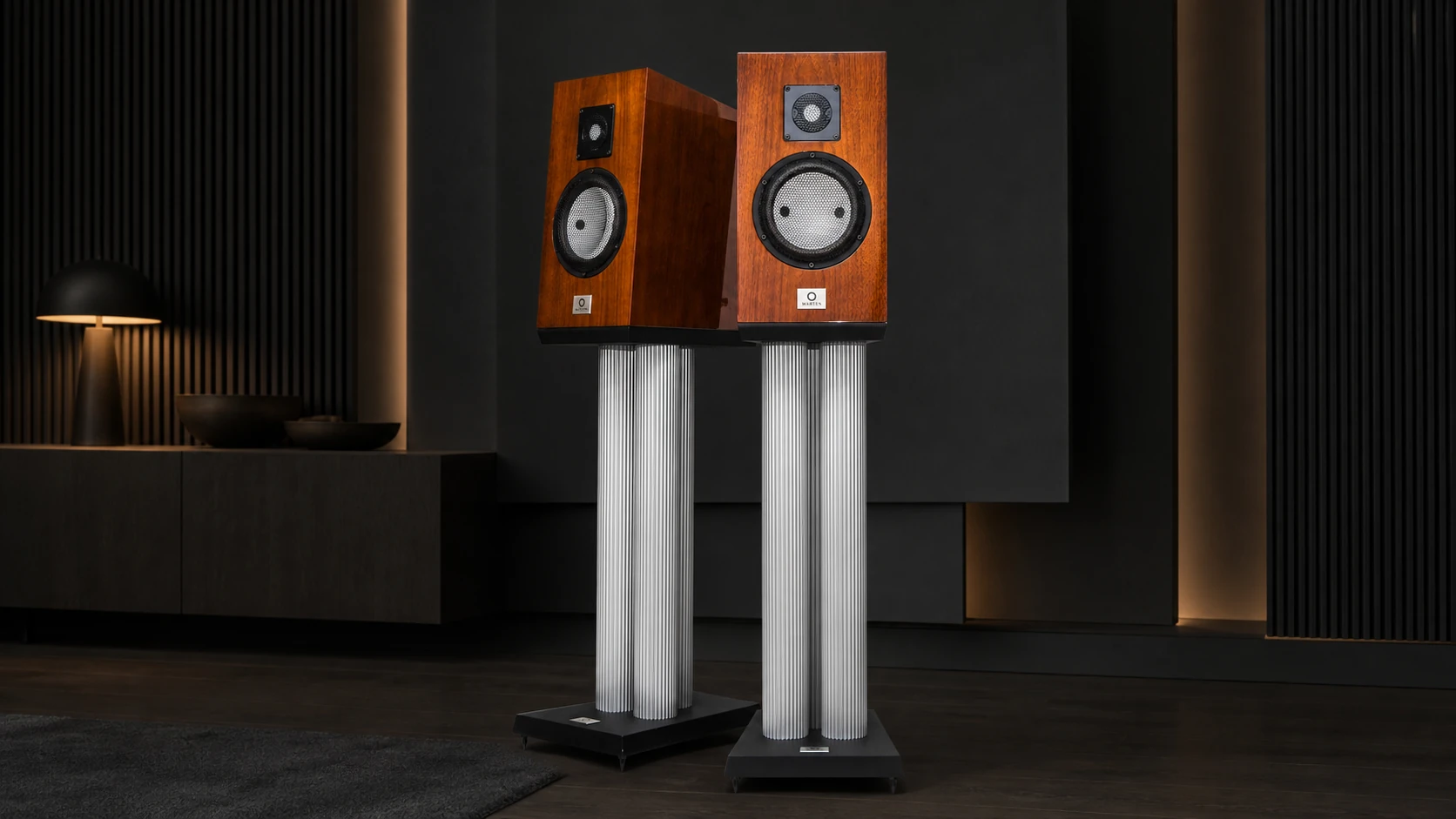
Marten Duke 2: sound character, engineering, and used-market context
The Marten Duke 2 is an uncompromising high-end monitor that marries the surgical speed of Accuton ceramic drivers with an unexpectedly organic harmonic bloom. Decades after its introduction, its holographic staging, transparent resolution, and refined crossover design make it a standout reference on the secondary market.
Marten Duke 2 — sound character, engineering, and used-market context
The Marten Duke 2 is a high-end, two-way stand-mount loudspeaker from the Gothenburg-based Swedish manufacturer Marten, originally priced between $8,500 and $9,500 (with dedicated stands adding roughly $1,250) and commanding between €3,200 and €4,200 on the secondary market in 2026. Within the landscape of luxury compact monitors, the Duke 2 occupies a distinctive position: it rejects the common trade-off between hyper-resolving analytical precision and long-term listening fatigue. Designed under the direction of founder and chief engineer Leif Mårten Olofsson as part of the refreshed Heritage series, the speaker pairs custom Accuton pure ceramic transducers with low-order filtration and bespoke internal cabling, demonstrating how rigid diaphragm materials can deliver acoustic transparency without mechanical hardness.
Rather than acting as a miniature compromise for listeners lacking space for floor-standing towers, the Duke 2 was conceived as a self-contained reference instrument. Its primary inquiry centers on whether a compact two-way architecture can replicate the natural harmonic scale, transient speed, and three-dimensional acoustic cues of a concert hall when freed from cabinet coloration. By combining a 23 mm trapezoidal cabinet with time-aligned baffle geometry and premium crossover topology, Marten engineered a monitor that behaves like an open window onto the recording chain, rewarding meticulous system synergy while revealing the subtle micro-dynamics of complex acoustic arrangements.
This article is part of a series of audio equipment analyses prepared on the basis of published reviews, manufacturer technical data, owner discussions, and available acoustic measurements. A detailed description of the methodology can be found in our standalone documentation.
Device DNA / constitutive traits
The core identity of the Marten Duke 2 is defined by the seamless fusion of extreme ceramic transient speed and an organic, full-bodied harmonic richness. Where conventional stiff-cone transducers often suffer from resonant breakup modes that introduce a metallic or clinical edge into the audible spectrum, the Duke 2 utilizes customized Accuton ceramic diaphragms damped by specialized acoustic absorption points and controlled by a phase-coherent second-order crossover. This design choice pushes mechanical breakup far beyond the operating band, allowing instruments and human voices to emerge with striking tactile immediacy, free from artificial overhang or synthetic sheen.
This speed is anchored by a structural design focused entirely on structural inertia and acoustic dispersion. The rigid 23 mm MDF enclosure employs non-parallel, trapezoidal side walls that taper towards the rear, eliminating internal flutter echoes and standing wave reinforcement, while the backward-tilted front baffle physically aligns the acoustic centers of the high-frequency dome and mid-bass cone. The resulting presentation yields a level of holographic spatial organization where the physical boundaries of the enclosures vanish entirely from the room, leaving a three-dimensional soundstage characterized by pinpoint localization, continuous ambient depth, and an unforced, grainless flow of musical information.
Quick decision profile
Key strengths:
- Exceptional holographic imaging and spatial depth, allowing the physical speaker enclosures to completely disappear within the listening space.
- Highly resolving Accuton ceramic drivers delivering pristine micro-detail, transient speed, and natural vocal timbre without high-frequency grain or listener fatigue.
- Remarkably agile, articulate, and tuneful low-frequency extension down to 38 Hz (±3 dB), exhibiting tight pitch definition and zero upper-bass overhang.
Main constraints and operational boundary conditions:
- Demanding 4-ohm nominal impedance (dipping to a 3.7-ohm minimum) requiring a stable, high-current amplifier with excellent damping and refined tonal balance.
- Rear-firing aerodynamic bass-reflex port necessitates generous physical clearance from rear and side boundaries (minimum 60–90 cm) to avoid low-end reinforcement.
- High acoustic transparency ruthlessly exposes bright upstream components, poor digital sources, and over-compressed recordings.
Who it is for / who it is not for:
The Marten Duke 2 is ideally suited for classical, jazz, vocal, and acoustic music connoisseurs operating in small-to-medium rooms (15–30 m²) who possess high-caliber tube or pure Class-A/AB solid-state amplification and demand reference-grade holography. It is decidedly less suitable for bass-heavy electronic or hard-rock enthusiasts seeking room-shaking sub-bass impact in large living areas, or for systems built around budget, forward-sounding electronics.
Construction, engineering, and physical requirements
The physical execution of the Marten Duke 2 represents a comprehensive study in vibration mitigation, acoustic time-alignment, and electrical purity. Manufactured in Sweden, the cabinet is fabricated from dense 23 mm medium-density fibreboard (MDF), selected for its uniform acoustic damping characteristics. Rather than relying on a conventional rectangular cuboid, chief designer Leif Olofsson implemented a trapezoidal cross-section in which the side walls taper continuously towards a significantly narrower rear baffle. This non-parallel internal geometry prevents the formation of standing waves and internal flutter echoes, eliminating cabinet-induced colorations that typically smear the lower midrange in compact monitors. Furthermore, the front baffle is tilted backward at a precise angle, physically offsetting the voice coils of the two drive units to align their acoustic centers at the listening position.
Both transducers are manufactured in Germany by Bernhard Thiel's pioneering Accuton (Thiel & Partner GmbH), universally recognized for producing pure alpha-corundum (aluminum oxide ceramic) diaphragms. The high-frequency register is handled by a 1-inch (25 mm) inverted ceramic dome tweeter shielded by a protective stainless steel mesh. The mid-bass driver is a 7-inch (180 mm) ceramic cone unit featuring a specialized long-throw motor assembly. The key distinguishing visual and technical element of this generation of Accuton mid-bass drivers is the presence of two dark acoustic damping dots (commonly referred to by audiophiles as „eyeball dampers”) strategically adhered to the cone perimeter. These damp the high-frequency breakup modes inherent to ultra-rigid ceramic membranes before they can energize the acoustic passband.
| Technical Parameter | Specification / Measured Value | Practical Audio and Engineering Implication |
|---|---|---|
| Acoustic Design Principle | 2-way, 2-driver bass reflex (rear-ported) | Point-source phase coherence combined with low-end port augmentation. |
| High-Frequency Driver | 1" (25 mm) Accuton pure ceramic inverted dome | Ultra-stiff, non-flexing diaphragm with breakup pushed beyond 40 kHz; protected by fixed metal mesh. |
| Low/Mid-Frequency Driver | 7" (180 mm) Accuton pure ceramic cone | Rapid transient response with zero cone flexing in passband; damped by dual perimeter dots. |
| Frequency Response | 38 Hz – 40,000 Hz (±3 dB) | Impressive low-frequency reach for a 20-liter net cabinet, delivering linear extension into the mid-30 Hz region in-room. |
| Crossover Frequency | 3,000 Hz | High crossover point keeps phase transitions away from the critical 1–2 kHz vocal intelligibility zone. |
Deep Dive: Accuton Ceramic Diaphragms and Resonance Control
The technical foundation of the Duke 2 rests on the physical properties of sintered alpha-corundum ceramic ($Al_2O_3$). Accuton creates these diaphragms by oxidizing pure aluminum foil in an electric plasma arc at extreme temperatures, forming a microscopic crystalline ceramic lattice with a hardness approaching diamond. Mechanically, ceramic possesses an exceptionally high stiffness-to-weight ratio and a speed of sound propagation through the material roughly three times higher than that of paper, polypropylene, or Kevlar. Consequently, the cone acts as a pure piston throughout its entire operational bandwidth, avoiding the chaotic modal breakups, cone flexings, and dynamic compression that plague softer materials during rapid acceleration.
Historically, the primary challenge of ceramic cones was their high Q-factor mechanical resonance at the upper boundary of their operating range: when an undamped ceramic cone reaches its breakup point, it produces a sharp, ringing peak that sounds unpleasantly harsh if improperly filtered. In the Duke 2, Leif Olofsson addressed this through a dual-layered engineering solution. First, Accuton integrated two viscoelastic damping spots directly onto the ceramic cone surface, absorbing mechanical vibrational modes across the cone radius. Second, Marten’s second-order crossover network utilizes high-purity Mundorf components—including heavy-gauge copper foil inductors that eliminate microphonic distortion and Supreme Silver/Gold in Oil capacitors—to sharply attenuate out-of-band energy. Coupled with pure copper Jorma Design internal wiring, this architecture allows the Duke 2 to extract the speed and resolution of ceramic transducers without any brittle, aggressive, or fatiguing artifacts.

What reviewers say
Professional audio critical reception for the Marten Duke 2 has consistently centered on its ability to transcend standard audiophile categories, delivering master-tape transparency alongside an unexpectedly natural harmonic flesh. Chief among its long-term documentation is the exhaustive critical coverage authored by Robert H. Levi in Positive Feedback Issue 65. Having lived with and owned the original Marten Duke monitors for years, Levi conducted a comprehensive evaluation of the Duke 2, ultimately purchasing the review pair as his long-term near-field and mid-field reference monitor. Levi reported that the transition to the updated Accuton 7-inch driver and refined crossover provided a 25 to 30 percent improvement in overall resolution, definition, and micro-dynamic expression compared to its predecessor, stating that the Duke 2 was as capable as any two-way monitor available on the global market.
Further analytical corroboration appears in British and European evaluations, including coverage in The Ear and Scandinavian surveys published by Inner Magazines. Reviewers across multiple territories agree that the Duke 2 achieves a degree of cabinet inertia and acoustic phase integration that allows the speakers to perform a total disappearing act within the listening room. Where discrepancies in reviewer impressions arise, they correlate almost exclusively with the amplification and room acoustics chosen for the evaluation. Reviewers who paired the Duke 2 with dry, forward-sounding solid-state electronics noted that the speakers did not disguise lean or clinical recordings, whereas those who deployed high-current tube amplifiers—such as the E.A.R. Yoshino V12 evaluated in Positive Feedback—or sweet Class-A solid-state designs reported an opulent, three-dimensional, and emotionally compelling musical experience.
Tonal Balance and Midrange Purity
The consensus regarding the Duke 2's midrange response emphasizes its uncolored neutrality, lack of nasal chestiness, and exceptional transient speed on vocal and acoustic string instruments. Rather than artificially boosting the 100–300 Hz upper-bass region to simulate a false sense of warmth and cabinet weight, the Duke 2 maintains a ruler-flat transition through the lower registers. Human voices—from baritone male vocals to operatic sopranos—are reproduced with a palpable sense of breath, mouth geometry, and throat resonance. Reviewers frequently remark on the absence of dynamic compression when complex choral pieces or multi-layered acoustic arrangements reach dynamic peaks. The ceramic mid-bass driver responds instantaneously to micro-inflections in volume, rendering the delicate vibrato of acoustic cellos and the subtle damper releases of grand pianos with vivid clarity.
High Frequencies, Air, and Holographic Staging
The high-frequency performance delivered by the 1-inch Accuton ceramic tweeter is universally lauded for its air, extension, and complete freedom from grain. Unlike hard metal domes that can exhibit an aggressive sizzle or soft textile domes that can roll off top-end air, the Duke 2’s tweeter reproduces high-hat cymbals, brushed snares, and violin overtones with delicate metallic sheen, realistic shimmer, and natural decay. In his Positive Feedback evaluation, Robert H. Levi characterized the high-frequency reproduction as „sweet, airy, and totally grainless,” highlighting how harmonic overtones float effortlessly within an expansive acoustic field. The dispersion characteristics of the concave ceramic dome, combined with the narrow front baffle, generate a holographic soundstage that extends well beyond the lateral boundaries of the speakers and portrays genuine layered depth from the front plane to the back wall of the recording venue.
Bass Dynamics, Articulation, and Timing
Low-frequency reproduction is where compact stand-mount monitors face their most rigorous acoustic test. Professional assessments consistently highlight that while the Duke 2 cannot defy the laws of physics to generate the sub-20 Hz visceral pressure of massive multi-driver floor-standers, its bass articulation within the 38 Hz to 120 Hz band is exemplary. The bass is described as exceptionally fast, tight, and pitch-accurate, free from the one-note overhang or tubby boominess common in ported bookshelf enclosures. Kick drums possess tactile impact with immediate leading-edge definition, while acoustic upright bass lines retain wood resonance and finger-on-string texture. In medium-sized listening rooms, room-boundary gain naturally supports the low-frequency output down into the mid-30 Hz region, providing a solid foundation for orchestral music and jazz trios alike.
Głos społeczności
Enthusiast discussions across dedicated high-end platforms—including the Audiogon community forum, the Naim Audio Community, the Audioshark Marten Owners Club, and Norwegian discussions on Hifisentralen—provide an extensive repository of real-world user experiences spanning more than a decade of ownership. The overriding sentiment among long-term owners is that the Duke 2 represents an endgame stand-mount loudspeaker for music lovers who value communicative transparency, spatial refinement, and acoustic realism over raw brute-force volume.
Community Pros and Cons
Most frequently praised attributes by owners:
- Unmatched Spatial Holography: Owners repeatedly celebrate the monitor’s uncanny ability to decouple sound from the speaker boxes, creating a vast, walk-in 3D soundfield even in modest room geometries.
- Micro-detail Without Fatigue: Enthusiasts on Audiogon and Naim Community emphasize that despite hearing unprecedented layers of low-level detail, they can listen for 4 to 6 hours continuously without listening fatigue when upstream electronics are properly matched.
- Impeccable Cabinet Craftsmanship: The mirror-like finish of the piano lacquer and deep luxury wood veneers (Walnut, Cherry, Maple) receives universal admiration as museum-grade furniture craftsmanship.
- Bass Speed and Pitch Articulation: Users in apartment settings praise the bass for its clean, articulate speed that never excites room boom or muddies the lower midrange.
Most frequent owner criticisms and practical warnings:
- Absolute Upstream Dependency: The speakers function as unvarnished sonic magnifying glasses. Owners warn that any glare, edge, or hash in the DAC, preamp, or speaker cabling will be exposed without forgiveness.
- Stand Mass and Rigidity Requirements: Placing the Duke 2 on lightweight, un-damped, or wobbly stands degrades low-end slam and smears imaging focus. Owners strongly urge using heavy, mass-loaded stands (such as the factory Marten stands or Solidsteel SS-6).
- Rear Wall Sensitivity: Due to the rear-firing reflex port, owners note that placing the speakers closer than 50–60 cm to the front wall results in an unnatural thickness in the upper bass and compresses soundstage depth.
- Delicate Ceramic Diaphragms: While protected by metal grilles, owners caution that ceramic cones are fragile and cannot withstand direct physical impacts, requiring careful handling during moves.
Long-term Reliability and Secondary Market Longevity
Unlike active streaming loudspeakers or digital processors that suffer from software obsolescence, the passive mechanical construction of the Marten Duke 2 has proven extraordinarily durable. Long-term reports across Audioshark and Hifisentralen indicate zero chronic failures regarding driver voice coils, surround rot, or crossover component degradation. The Mundorf capacitors and copper foil coils maintain their electrical tolerances over decades of use. On the secondary market, tracked through HiFi Shark and Audio Mart classifieds, clean pairs of Duke 2 trade in the €3,200 to €4,200 range ($3,500–$4,600). Because owners tend to retain them as permanent references, used inventory is relatively scarce, and well-maintained pairs with original flight crates and matching stands hold their resale value with remarkable stability.
Two radars
The synthesized acoustic and operational profile of the Marten Duke 2 is formalized through HiFi Grail’s Dual Radar framework, which maps nine sound character axes alongside six practical room-and-system operational metrics. Rather than serving as an arbitrary scorecard, these radar vectors capture the structural relationships and engineering trade-offs embedded in Leif Olofsson’s acoustic design.
RADAR_SOUND_DATA:
tonal: 88
bass: 80
mid: 92
treble: 93
dyn: 85
stage: 94
res: 93
timbre: 89
value: 84

RADAR_ACOUSTIC_DATA:
quiet: 82
loud: 80
transparency: 94
fatigue: 86
synergy: 54
tolerance: 62
Sound Radar Commentary
The sound radar profile of the Marten Duke 2 reveals a loudspeaker engineered for maximum transparency, speed, and spatial holography, resting on a remarkably balanced tonal foundation.
- Tonal Balance (
tonal): The monitor maintains a strictly neutral, linear frequency response across the audible spectrum, avoiding both artificial midrange bloom and aggressive treble shelving. - Bass (
bass): Low-frequency performance is fast, taut, and pitch-precise, delivering agile transient response down to its 38 Hz cutoff while exhibiting zero overhang or cabinet resonance. - Midrange (
mid): The midrange register is exceptionally transparent, textured, and open, allowing vocal inflections and acoustic instruments to materialize with direct physical presence. - Treble (
treble): High-frequency extension from the Accuton ceramic tweeter is airy, highly resolving, and completely free from high-Q ringing or grain. - Dynamics (
dyn): Micro-dynamic gradation is virtually instantaneous due to the ultra-light ceramic moving mass, while macro-dynamic scale is limited only by compact cabinet displacement. - Soundstage (
stage): Three-dimensional staging is a defining masterclass, presenting expansive width, continuous depth layering, and pinpoint holographic focus that completely detaches sound from the physical enclosures. - Resolution (
res): Low-level detail retrieval operates at an archival standard, unearthing subtle ambient cues, room acoustics, and micro-harmonic decays without clinical edge. - Timbre (): Harmonic rendering is natural, liquid, and uncolored, benefiting directly from Mundorf Supreme Silver/Gold/Oil crossover components and Jorma Design pure copper cabling.
Acoustic Radar Commentary
The acoustic and operational radar illustrates the practical compromises inherent to a highly revealing, rear-ported reference monitor.
- Low-Volume Listening (
quiet): The low inertia of the rigid ceramic diaphragms enables the Duke 2 to preserve full dynamic contrast, tonal balance, and spatial layering even at whisper-quiet late-night listening levels. - High-Volume Capability (
loud): The non-flexing ceramic cones withstand substantial acoustic drive without dynamic compression or modal distortion, though physical enclosure volume sets practical limits in cavernous spaces. - Acoustic Transparency (
transparency): Operating as a pure acoustic conduit, the loudspeaker exhibits minimal intrinsic voice, faithfully mirroring upstream electronics and source material. - Fatigue Resistance (
fatigue): When driven by smooth, high-current amplification, the lack of diaphragm breakup modes ensures that extended multi-hour listening sessions remain effortless and engaging. - Application Synergy (
synergy): The low rating reflects high application selectivity: the 4-ohm impedance curve (3.7-ohm minimum), rear bass-reflex port, and unsparing resolution demand careful amplifier matching, heavy stands, and proper room positioning. - Tolerance to Poor Recordings (
tolerance): The monitor’s unsparing resolving power provides limited forgiveness for harsh, brickwalled, or dynamically crushed masters, presenting source flaws with strict fidelity.
For whom in particular
Profile 1: The Chamber, Jazz, and Vocal Purist in Medium-Sized Rooms
- Fit: Perfect fit.
- Rationale: For listeners whose musical diet centers on acoustic jazz trios, string quartets, baroque ensembles, and intimate vocal recordings in rooms between 15 and 30 m², the Duke 2 is in its absolute element. Its ability to reproduce the micro-texture of a bowed cello, the breath control of a vocalist, and the ambient decay of a church acoustic is virtually peerless in this physical footprint.
- System Requirements: High-quality push-pull tube amplification (e.g., E.A.R. Yoshino V12, Audio Research) or Class-A solid-state (e.g., Luxman L-590AXII, Pass Labs INT-60), matched with dedicated mass-loaded stands.
Profile 2: The Studio Mastering Engineer or Archival Evaluator
- Fit: Fits with specific operational conditions.
- Rationale: Master-tape transparency and rapid transient response make the Duke 2 an exceptional near-to-mid-field mastering monitor. It exposes micro-flaws in editing, digital filtering artifacts, and compression boundaries instantly.
- System Requirements: Requires dedicated acoustic treatment at first reflection points and high-current, low-distortion studio amplification to prevent room reflections from obscuring the monitor’s native phase accuracy.
Profile 3: The Hard Rock, Heavy Metal, and Modern Electronic Enthusiast
- Fit: Does not fit without sub-bass augmentation.
- Rationale: Listeners demanding bone-crushing, sub-30 Hz physical impact and sustained high-SPL wall-of-sound energy in large listening spaces will find the Duke 2 physically constrained by its two-way, single 7-inch woofer architecture.
- System Requirements: If pursued, requires integration with a high-speed active subwoofer system (such as the legacy Marten Ellington or dual REL S/510 units) crossed over cleanly to relieve the monitor from deep bass excursion.
Profile 4: The Vintage/Casual Hi-Fi Enthusiast with Forward Upstream Gear
- Fit: Decidedly poor fit.
- Rationale: In systems utilizing bright vintage solid-state receivers, budget Class-D power modules, or aggressive Sabre-based DACs without refined analog stages, the Duke 2 will mercilessly highlight electrical hash and tonal glare, leading to a sterile, fatiguing sound.
- System Requirements: Requires a fundamental overhaul of upstream components towards high-current, harmonic-rich electronics before the speakers can be appreciated.

Market positioning and real alternatives
Within the upper tier of the luxury stand-mount market, the Marten Duke 2 competes against a distinguished cohort of reference monitors, each embodying a radically different structural and material philosophy.
Marten Duke 2 vs. Focal Sopra No1 / Electra 1008 Be2
The French approach, exemplified by the Focal Electra 1008 Be2 and its successor the Sopra No1, is built around inverted beryllium dome tweeters and glass/foam composite W-cones. In direct comparison, the Focal monitors offer a slightly more forward, energetic presence in the lower treble and a punchier, more forward mid-bass snap. By contrast, the Marten Duke 2 presents a deeper, more atmospheric soundstage with greater harmonic liquidity through the midrange. Where Focal dazzles with upfront speed and immediacy, Marten seduces with holographic space, effortless decay, and a more relaxed, grainless top-end flow.
Marten Duke 2 vs. Magico A1
The Magico A1 represents the pinnacle of sealed-box, aircraft-grade 6061-T6 aluminum cabinet engineering, utilizing a pure beryllium tweeter and a graphene Nano-Tec carbon mid-bass cone. The Magico A1 offers unmatched cabinet silence, absolute low-end damping, and a surgical, studio-dry bass character that is virtually immune to room boundary boom. However, the Duke 2 counters with a more expansive, breathy acoustic presentation, greater bloom on wood instruments, and a more organic, holographic projection into the room, making the Marten more emotionally communicative for classical and acoustic jazz aficionados.
Marten Duke 2 vs. Bowers & Wilkins 805 D3 / D4
The Bowers & Wilkins 805 series features the iconic diamond dome mounted in a solid-aluminum body on top of a curved cabinet housing a Continuum cone. The B&W 805 D3/D4 produces a punchy, highly structured, and dynamic presentation with an energetic top-end bite that excels at rock, pop, and modern production. However, the Marten Duke 2 exhibits significantly less listening fatigue and a smoother, more unified crossover transition at 3 kHz. The Duke 2 avoids the prominent high-frequency peak of the diamond tweeter, delivering a more neutral, balanced, and cohesive acoustic tapestry across long listening sessions.
Marten Duke 2 vs. Harbeth Monitor 30.2
The Harbeth Monitor 30.2, derived from the BBC LS5/9 lineage, utilizes a lossy, thin-wall plywood cabinet and a proprietary RADIAL2 polymer cone. The Harbeth excels at warm, creamy vocal density, chest resonance, and forgiving handling of poorly mastered recordings. The Marten Duke 2 operates in an entirely different league of transient speed, resolution, top-end air, and three-dimensional imaging. Where the Harbeth is warm, romantic, and slightly sluggish on complex percussion, the Duke 2 is lightning-fast, transparent, and holographic.
Linia wersji
The Duke model lineage represents an essential chapter in the evolutionary history of Marten’s loudspeaker engineering, spanning over two decades of refinement in ceramic driver implementation.
| Generation / Version | Production Period | Core Technical Differentiators | Market Status & Used Valuation |
|---|---|---|---|
| Marten Duke (Original) | 2005 – 2012 | 1" ceramic tweeter, early-generation 7" Accuton mid-bass without damping dots; bi-wiring terminals; optional Ellington active bass module. | Legacy / Discontinued. Secondary market ~€1,800–€2,400. High value, but slightly higher risk of driver breakup glare compared to Mk2. |
| Marten Duke 2 (Heritage) | 2012/2013 – ca. 2020 | Refined Accuton drivers with dual dot resonance dampers; 2nd order Mundorf Supreme Silver/Gold/Oil crossover; Jorma Design pure copper cabling; single-wire WBT terminals. | Analyzed Subject / Discontinued. Secondary market ~€3,200–€4,200 ($3,500–$4,600). Sweet-spot reference monitor combining modern ceramic refinement with classic furniture-grade woodworking. |
| Marten Oscar Duo | 2019 – Present | Custom-designed Marten 7" ceramic mid-bass and 1" ceramic tweeter; contemporary streamlined cabinet styling; simplified crossover network. | Current Entry-level Series. Retail ~€6,500–€7,000. Modernized industrial design, slightly warmer balance, but less bespoke crossover componentry than Heritage Duke 2. |
| Marten Parker Duo |
Used Market Buying Guidance in 2026
On the 2026 pre-owned market, the Marten Duke 2 occupies a highly advantageous position. Because the successor Parker Duo has escalated substantially in retail price (starting above €11,000), a pre-owned Duke 2 in pristine condition at €3,200 to €4,200 delivers roughly 85–90% of Marten's flagship monitor transparency at less than a third of the investment. Prospective buyers should inspect the ceramic drive units carefully using directional light: the ceramic surfaces must be pristine, without hairline fractures, spider cracks, or missing protective grille meshes. Verified provenance, original heavy-duty flight cases, and the presence of dedicated factory stands represent significant added value on the secondary market.
Synergia systemowa i dopasowanie do pokoju
Extracting the full sonic potential of the Marten Duke 2 requires viewing the loudspeaker not as an isolated component, but as the terminating acoustic transducer of a carefully curated electrical and mechanical system.
RECOMMENDED SYSTEM CONFIGURATIONS:

Configuration A — The Harmonic & Holographic Reference (Vacuum Tube):
- Amplification: E.A.R. Yoshino V12 (50W Push-Pull EL84) or PrimaLuna Dialogue Premium HP (KT150).
- Source: High-end R-2R Ladder DAC (e.g., Holo Audio May KTE, Denafrips Terminator) or Reference Turntable.
- Cabling: Jorma Design Trinity / Duality or pure continuous-cast copper (e.g., Cardas Clear Reflection).
- Sound Result: Boundless three-dimensional soundstage, liquid vocal texture, velvet high-frequency decay.

Configuration B — The Dynamic & Gripping Reference (High-Current Solid-State):
- Amplification: Luxman L-590AXII (Pure Class-A 30W/60W) or Gryphon Diablo 120 / Atilla or Naim NAP 250 DR.
- Source: High-resolution streaming transport with ultra-low phase noise clocking.
- Cabling: Nordost Frey 2 or Acrolink 7N pure copper.
- Sound Result: Ferocious bass transient speed, razor-sharp pitch definition, pitch-black background noise floor.
Amplifier Matching and Electrical Behavior
While Marten rates the Duke 2 with an 88 dB sensitivity and a nominal 4-ohm impedance, the loudspeaker presents a remarkably stable and well-behaved electrical load. The impedance curve dips to a benign minimum of 3.7 ohms at approximately 160 Hz, avoiding the punishing sub-2-ohm drops or steep capacitive phase angles that destabilize vacuum tube output transformers. Consequently, tube amplifiers with robust 4-ohm secondary taps—particularly those utilizing push-pull topologies with high-transconductance pentodes or EL84 arrays—perform with glorious harmonic authority. When paired with solid-state amplification, the Duke 2 thrives on high-bias Class-A or stiff, high-damping Class-AB designs capable of delivering clean current into low impedances. Low-cost Class-D amplifiers or underpowered integrated units should be strictly avoided, as their higher output impedance and elevated high-frequency switching noise can induce a clinical, two-dimensional character through the ceramic tweeter.
Room Sizing, Placement Geometry, and Boundary Clearance
The Duke 2 is optimized for listening spaces ranging from 15 to 30 m² (160–320 sq. ft.). In rooms of this scale, the monitor achieves a seamless balance between low-frequency boundary reinforcement and direct-field clarity. Because the bass-reflex port vents directly out the rear baffle, boundary placement is critical:
- Rear Wall Clearance: Maintain a minimum distance of 60 to 90 cm (24–36 inches) between the rear panel and the front wall. Placing the monitors too close to the boundary excites room boundary boom in the 60–100 Hz region and compresses the front-to-back soundstage depth.
- Side Wall Clearance: Allow at least 50 cm of clearance from side boundaries to prevent early lateral reflections from smearing high-frequency localization.
- Toe-in Angle: The wide, uniform dispersion of the concave ceramic tweeter requires only modest toe-in (roughly 5 to 10 degrees towards the listening position). Direct on-axis aiming is rarely necessary and can slightly narrow the sweet spot, whereas a gentle toe-in locks in a rock-solid center vocal image while maintaining an expansive soundstage width.
- Support Stands: The monitors must be mounted on rigid, mass-damped stands with an optimal height of 60 cm (24 inches), placing the ceramic tweeter directly at seated ear level. Coupling the stands to the floor via hardened steel spikes is mandatory to prevent cabinet rocking during dynamic bass transients.
Low-Volume Performance, Fatigue, and Extreme Scenarios
At late-night listening levels (55–65 dB SPL), the Duke 2 demonstrates one of its most compelling attributes. The exceptional lightness of the Accuton ceramic cones, combined with the low dielectric absorption of Mundorf crossover capacitors, ensures that the frequency spectrum remains fully fleshed out even when the amplifiers are barely idling. Bass lines retain their melodic contour and the soundstage retains its three-dimensional layering without the dull, veiled collapse typical of heavier cone materials.
Conversely, under extreme high-SPL stress tests (>90 dB continuous in large 50 m² halls), the physical displacement limits of a single 7-inch driver become audible as mechanical compression on heavy orchestral bass drum hits or deep synthesizer sweeps. The monitor never loses composure in the midrange or treble—the ceramic cones remain pistonic and free from breakup—but the low end gracefully reaches its excursion limit. In such large spaces, pairing the Duke 2 with high-speed, line-level augmented subwoofers relieves the mid-bass cone of sub-50 Hz duties, allowing the system to achieve staggering dynamic scale while preserving the Duke 2’s magical holographic imaging.
Sources
- https://positive-feedback.com/Issue65/marten_duke.htm
- https://positive-feedback.com/Issue56/ear_v12.htm
- https://positive-feedback.com/staff-members/robert-h-levi/
- https://absolutehiend.com/index.php/marten-duke-2.html
- https://www.marten.se/heritage/
- https://harmonyhifi.co.uk/marten-duke-2
- https://www.inner-magazines.com/audiophilia/marten-heritage-series/
- https://forum.audiogon.com/discussions/marten-duke-2-speakers
- https://community.naimaudio.com/t/marten-duke-ii-with-naim-amplification/14582
- https://www.audioshark.org/marten-audio-176/marten-duke-2-impressions-12940.html