
Java Hi-Fi Single Shot MK1 pre-R2R: GaN speed, LDR precision, and the case for the Burr-Brown revision
The pre-R2R Single Shot is a 200-watt GaN class-D integrated built around transparency and timing rather than warmth. Its DAC has since been replaced by an in-house R2R stage, making this the version that now lives on the used market — and argues its case on sound character, not spec sheet freshness.
Java Hi-Fi Single Shot MK1 pre-R2R
Intro
The Java Hi-Fi Single Shot in its older Burr-Brown DAC revision — the version that predates the brand's transition to an in-house R2R stage in 2025 — was priced at launch at around US$8,995–9,495, GBP 9,290, or NZD 11,495, depending on market and finish. At first glance, this is the kind of product that can trigger caution: an exotic brand from New Zealand, a heavily design-led amplifier with a wooden enclosure, class D on GaN FETs, LDR volume control, a built-in USB DAC, MM phono, Bluetooth aptX, and a headphone output. That combination is easy to mistake for a product trying to sell style, modern buzzwords, and convenience in a single box. The problem is that too many independent sources describe the Single Shot in too similar a way to dismiss it as merely a stylish object.
The same points recur consistently across reviews: fast transient attack and decay, strong bass control, lively timing, transparency without the glaze associated with weaker class-D designs, and a sense that this amplifier does not conceal differences between recordings or loudspeakers. At the same time, there is no consensus on whether the Single Shot adds enough saturation and warmth in the midrange to satisfy someone accustomed to more relaxed solid-state or valve integrateds. That matters, because it frames the entire narrative around the device: not as a safe all-rounder, but as a deliberate choice for someone who wants energy, control, and clarity without tipping into sterility.
The revision analysed here is additionally notable for one specific reason. From 31 March 2025, with a rollout from May 2025, Java began communicating new variants featuring an in-house dual AD1865 non-oversampling R2R DAC. This means the Single Shot name now covers a different digital stage than the model evaluated by reviewers in 2023–2024. That is precisely why the older version warrants separate treatment: not as "worse because older", but as a distinct purchase profile that today makes sense primarily on the used market or in remaining dealer stock.
This text is a synthesis of manufacturer data, professional reviews, and a thinner but still useful community layer. It does not pretend to first-hand listening. Its purpose is to answer a simpler and more practical question: what is the Single Shot MK1 pre-R2R in its essence, for whom does its character make sense, and where the line falls between genuine strengths and the attractive mythology of a niche brand.
DNA of the device
The first defining characteristic of the Single Shot is speed without nervousness. Hi-Fi+, Twittering Machines, Tone Publications, and Witchdoctor all describe it as a very alive, immediate amplifier with strong transient composure. Reviews do not paint a picture of a lumbering all-in-one compensating with features for what it fails to deliver musically. On the contrary, the source consensus points to substantial energy reserves, confident rhythmic drive, and an ability to maintain bass order without turning music into a laboratory experiment.
The second characteristic is transparency towards the signal chain. The Single Shot is not described by sources as an amplifier in the "everything will sound more pleasant" category. Reviewers consistently note that it is capable of revealing the character of loudspeakers, recordings, and upstream components. In practice this is an advantage in a well-matched system, but it also implies a reduced tendency to mask weaker recordings or a sharply assembled chain. This is an integrated built more around ordering and resolving than beautifying.
The third characteristic is completeness without domestic multimedia sprawl. The built-in DAC, MM phono, Bluetooth, and headphone output mean the Single Shot genuinely closes a system in a single box. At the same time it does not try to be an AV receiver for everything. There is no HDMI, no optical input, no networked streaming stage. It is a product for stereo, and for a listener who values a direct signal path over the versatility of a home cinema hub.
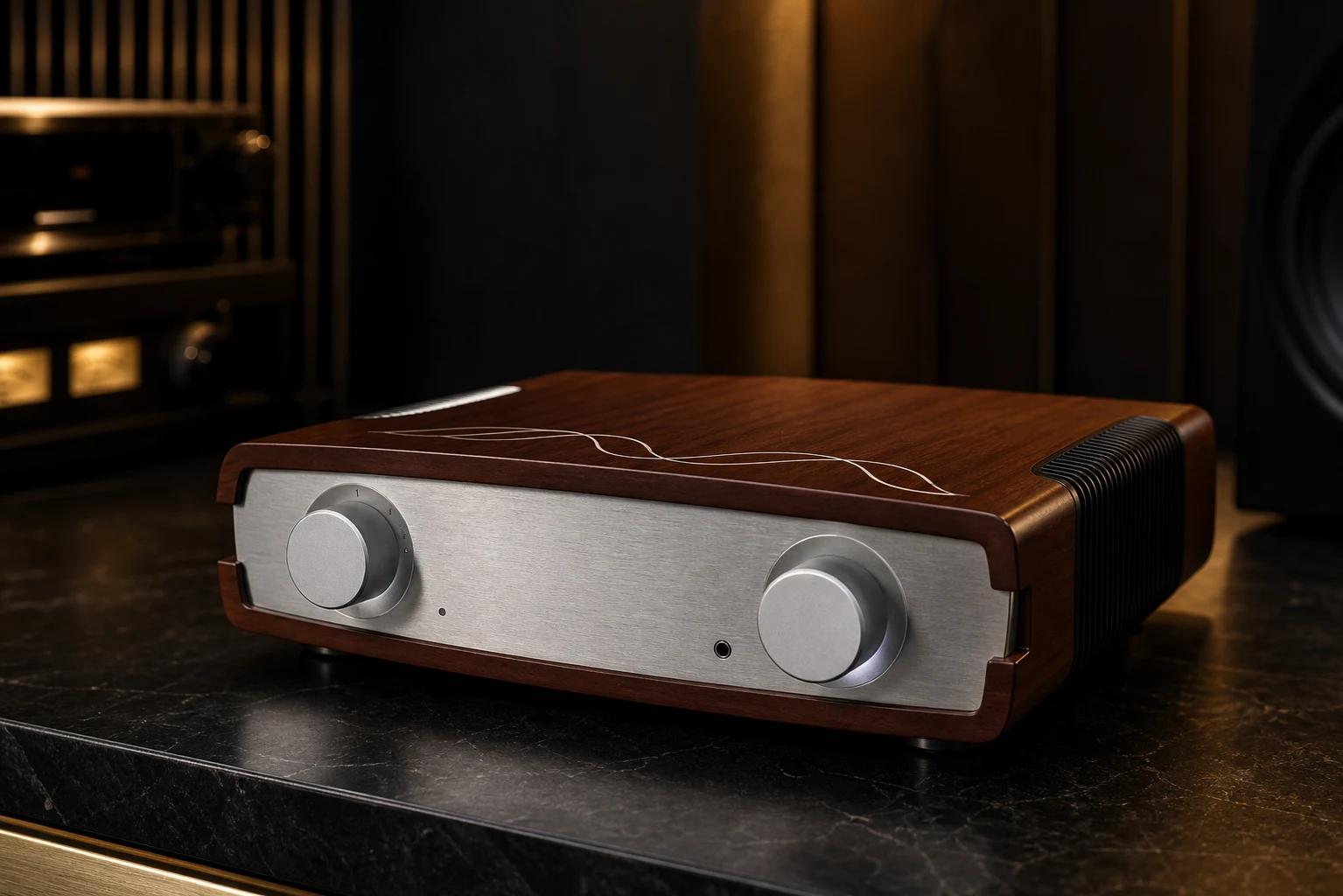
The fourth characteristic is aesthetic but not peripheral: strong object identity. In a segment where many premium integrateds still look like subtly restyled boxes, Java attempts differentiation through finish, natural wood, lateral heatsinks, and customisation options. Here the form does not replace the content — it is integral to the offer.
Quick decision profile
3 strongest assets
- Very strong rhythmic drive, fast transients, and solid control of the lower register.
- A rare combination of audiophile integrated with a genuinely capable MM phono stage, USB DAC, and headphone output.
- Distinctive premium aesthetics without signals that design is covering for average sound.
3 main reservations or boundary conditions
- This is not an amplifier for someone expecting natural sweetening of everything through the character of the device itself.
- The digital stage of the older revision is now measurably less current than the 2025 R2R version.
- Public owner material and measurement data are thinner than for more mainstream high-end brands.
For whom / for whom not
Most appropriate for a listener who wants a compact stereo system with a fast, transparent, and defined character and who wants to know what is actually happening in the recording and the chain. Less obvious for someone seeking something more romantic, forgiving, or maximally future-proof on the digital side.
Build and technical specification
The Single Shot MK1 pre-R2R is a stereo integrated amplifier built around two ideas the brand has made its proprietary signature, as documented on the Java Hi-Fi product page: an LDR preamp stage and a GaN FET power stage. In practice this means a passively biased volume control based on light-dependent resistors and a class-D output stage using gallium nitride transistors. The manufacturer has long argued that this combination delivers signal purity and low interference alongside the efficiency and speed of modern class D. That argument would mean little if reviewers did not actually describe this amplifier in exactly those terms — speed, absence of smear, and good organisation.
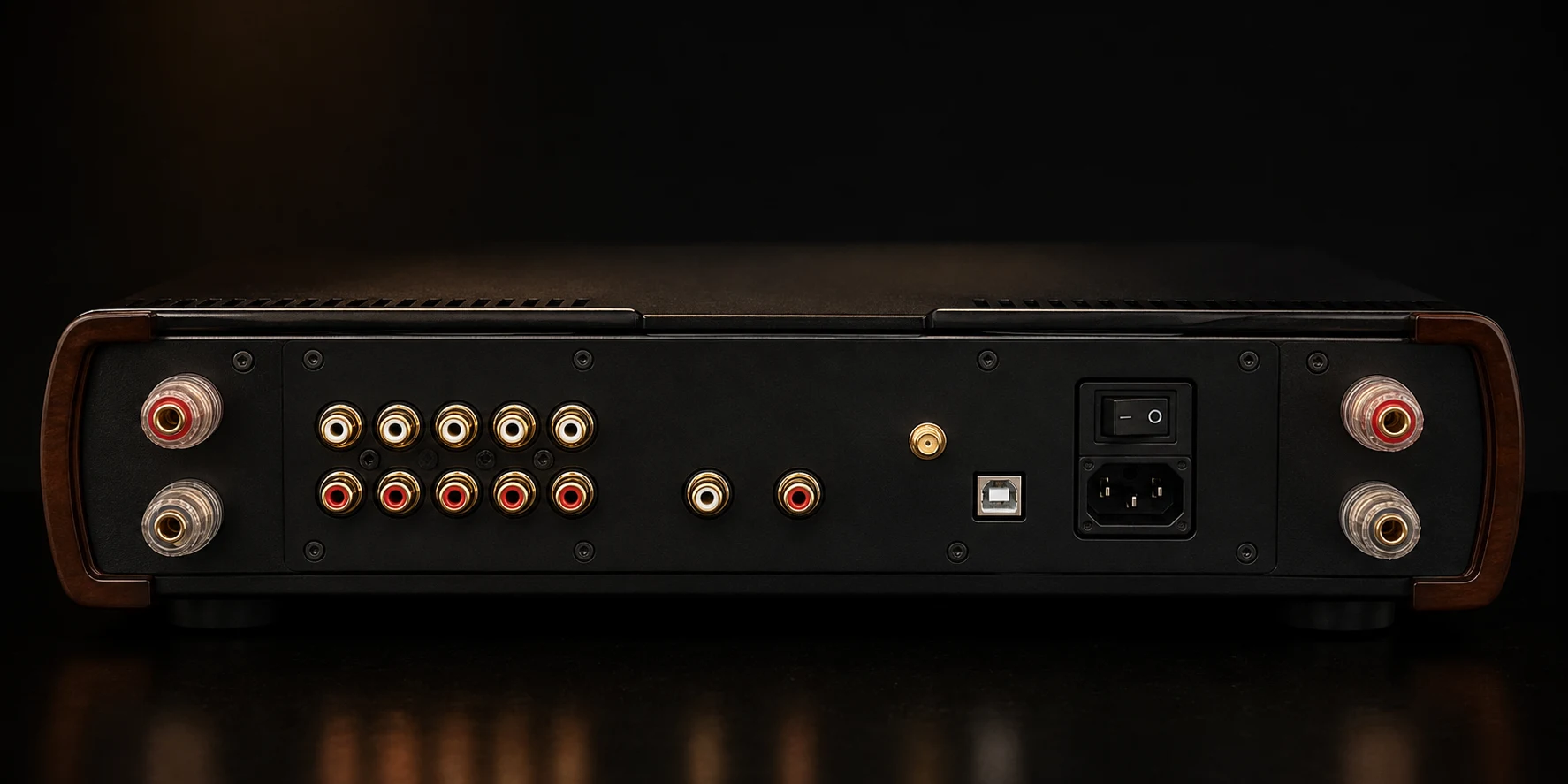
The core functionality of the reviewed revision is strong. There are 200 W per channel at 8 ohms and 400 W at 4 ohms, two pairs of RCA line inputs, a pre-out, an MM phono input, a USB port for the built-in DAC, Bluetooth aptX, and a front-panel 6.35 mm headphone output. That set is enough for many users to close the chapter on a separate phono stage, DAC, and headphone amplifier, provided the configuration is to remain a stereo system without television-era conveniences.
One important clarification for this specific analysis: the older DAC section is not what Java currently communicates on its product page. According to Twittering Machines and Witchdoctor, the pre-R2R version uses dual Burr-Brown PCM1794A chips, with the USB port handling PCM up to 24/192 and DSD128, though Witchdoctor notes that DSD is not processed natively but converted to PCM. Hi-Fi+ adds the practical observation that this DAC is musical and capable, but not particularly focused on very high sample rates. That is a meaningful nuance: the built-in DAC does not look like a token feature, but in 2026 it is no longer the main advantage of this revision over the newer R2R.
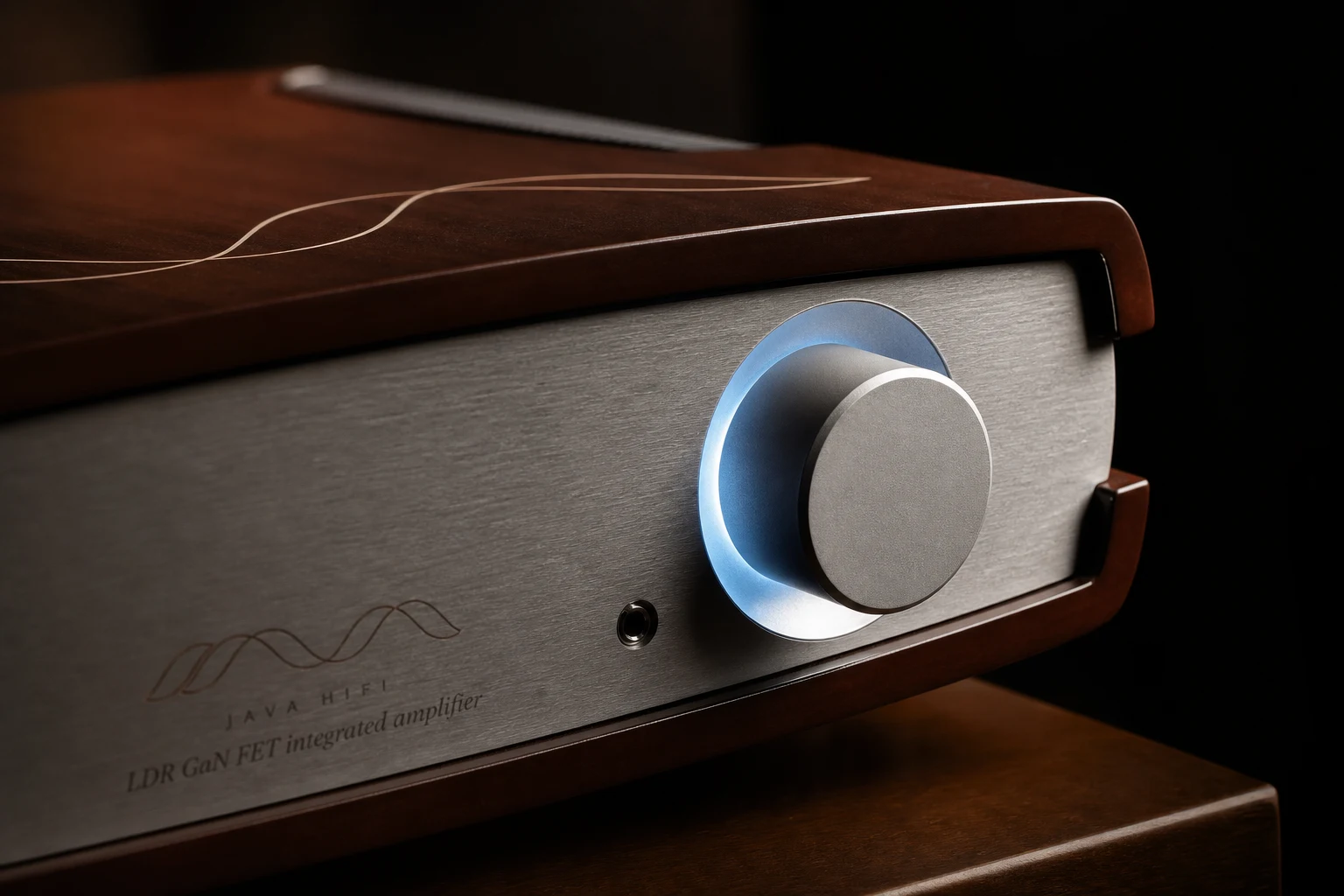
Physically, the Single Shot is a distinctive object. Reviews highlight an 8 mm anodised front panel, large control knobs, prominent lateral heatsinks, and an enclosure finished in natural veneer or other finish options. The manufacturer's positioning makes clear that the look is not fixed — customers can select combinations of wood, front panel finish, and overall aesthetic. On one level this is a lifestyle element; on another it has real significance in domestic high-end, where an integrated often occupies a visible position for years and is sometimes purchased as much as an object as a piece of electronics.
Practically useful details also recur: a clearly labelled rear panel, ETI Research binding posts, a proper remote, a non-excessive set of options, and an inverted PCB mount the manufacturer describes as aiding resonance control. The effectiveness of the last detail cannot be independently verified from available sources, but the construction does not appear to be cost-reduced.
In daily use, a few details return consistently. Hi-Fi+ notes that the volume display does not function as a precise step counter but more as a system of illuminated segments, and that the amplifier has been voiced to provide more useful gradations between "zero" and "one" at lower listening levels. That may sound like a minor detail, but in practice it matters: many powerful amplifiers become unwieldy at quiet listening levels when the first two steps decide everything. Here at least one review suggests Java addressed the problem deliberately, which fits well with the profile of a device conceived for everyday domestic use rather than only high-volume showcase sessions.
The character of the digital section is equally practical. The older DAC has nothing futuristic about it today, but it has something more important: sources do not describe it as an obvious bottleneck. Hi-Fi+ finds in it good timing and an ability to distinguish the character of transports and streamers; Witchdoctor notes a tonal resemblance to the in-house Electrocompaniet converter; and Twittering Machines simply does not treat it as an add-on, but as a serious element of the reviewed system. That still does not make it a definitive argument for serious file-format enthusiasts, but it prevents the USB input from being written off as emergency connectivity.
Limitations exist. The Single Shot is clearly designed around music, not around everything. Anyone needing optical, coaxial, HDMI ARC, network streaming, or an MC phono input will not find them here. Weight figures are inconsistent in public sources: Hi-Fi+ and the HiFi Engine library entry give 10.6 kg, one dealer listing on Playback Distribution lists 9.5 kg, while the current product page for the newer R2R version states 14.1 kg. It is safest to treat 10.6 kg as the most frequently cited figure for the older variant, without claiming certainty.
Overall, the Single Shot's technical section does not shout "revolution on paper" — it assembles several sensible choices into a coherent whole. What is most interesting is that sources do not describe it as a functional compromise. That is precisely why its specification becomes meaningful only once it is clear that the features serve the sound rather than a marketing bullet list.
What reviewers say
The review layer is stronger than one might assume for a niche brand, and — more importantly — it is remarkably consistent. The Hi-Fi+ review by Jason Kennedy describes the Single Shot as an amplifier with pronounced immediacy that makes music more alive and exciting. Jason Kennedy contrasts it with what he calls the typical thickener associated with certain class AB amplifiers: Java is said not to add mass for its own sake but to remove a sense of heaviness. That immediately sets the centre of gravity for the entire analysis. The Single Shot does not want to be a large, dense, calming integrated. It wants to be fast, legible, and energetic.
The same Hi-Fi+ text adds an important qualification. Kennedy notes that Java avoids the opposite extreme — the thinness and hollowness that can afflict weaker class-D amplifiers. He writes of a degree of richness and depth of tone sufficient to prevent the sound from recalling laboratory austerity. This is a valuable observation because it explains why the Single Shot is so frequently praised despite its transparency: it does not sound like a diagnostic tool, but like a device that is fast and still musical.
Twittering Machines moves further into positive energy and control. Michael Lavorgna describes the pairing with YG Summit as one where Java provides effortless, clean, clear, and rich power, along with speed of light transients, explosive dynamics, and fast, full-range bass. Even if such phrasing is more journalistic than engineering, it remains consistent with other sources: the Single Shot performs well with loudspeakers that quickly expose nervousness or artificiality in amplification.
The Tone Publications review by Jeff Dorgay adds a similar point from a different angle. Dorgay, declaring scepticism in the text about class-D stereotypes, writes directly that Java rewrites the book on the harshness associated with that class. Particularly significant is the passage about the combination with resolving YG Acoustics Cairn speakers — not a forgiving partner — which makes the positive assessment of that synergy something other than an accidental compliment.
Witchdoctor's Andrew Baker brings the necessary dose of sobriety. Baker is strongly positive about the Single Shot, praising its texture, natural timbre, black background, and general liveliness, but he explicitly records that on War Pigs he would have liked a little more body or warmth through the midrange to balance the top end. That is the key moment, confirming that Java does not automatically beautify demanding material. Transparency is an asset here, but it has a cost. Someone expecting a premium integrated to add a veneer of smoothness to every recording may find a different profile than the one they were seeking.
At the same time Baker praises the phono and headphone stages strongly. This distinguishes the Single Shot from many integrateds where add-ons exist only to tick boxes in a brochure. At Witchdoctor the phono does not read as a temporary substitute, but as something that genuinely allows vinyl listening without an immediate urge to add an outboard stage.
HiFi Chicken (Anton) from December 2024 confirms this practical dimension. The author praises the neutrality, power, and built-in features, and notes that the MM phono sounds better than entry-level external stages tested alongside it. That does not make the Single Shot's phono an objective champion of specialised stages, but it reinforces the thesis that the entire product was designed to function as a genuinely self-sufficient stereo hub.
The consistency of the description across functional sections is also significant. In many integrateds, reviewers split the amplifier itself from "the rest", clearly implying that the DAC or phono is merely acceptable. Here that gap is small. Reviewers do not claim the built-in converter bests similarly priced outboard DACs, but they consistently convey that using it is not a penalty for convenience.
Worth noting is what is largely absent from the reviews: there are few complaints about loss of control, bloated bass, artificial staging, or fatigue from coarse grain. When reservations appear, they concern the aesthetic profile of the sound — the amount of warmth, tolerance for weaker recordings, or the future-readiness of the older DAC — not the basic competence of the amplifier as a device imposing musical order.
Distilled to a single axis, the review corpus reads: the Single Shot is a fast, transparent, dynamic, well-controlled amplifier that is less sterile than many listeners might expect from class D. Less clear is whether it offers sufficient midrange body for every repertoire and every listener. But that ambiguous area is here an honest distinguishing feature, not a flaw in the methodology. Show coverage from AudioKeyReviews at Capital Audio Fest 2024 and The Absolute Sound at Capitol Audio Fest 2023 extends the same pattern into live demo conditions.
Community voice
The community layer for the Single Shot is not as rich as for brands with broader market presence or for models that have lived on forums in dozens of systems over years. That must be stated at the outset, because otherwise it is easy to over-interpret the data. Even so, the material is not empty and offers a few useful practical threads.
The most technically interesting is the older StereoNET thread about Java from when the brand was primarily associated with LDR technology, complemented by the StereoNET launch news for the newer Carbon series amplifiers. The discussion does not concern the Single Shot integrated specifically, but explains why LDR attracted interest: participants discuss variable output impedance and the behaviour of the circuit at different volume levels. This is not a ready listening conclusion, but it shows that for technically inclined buyers the concept was not treated as a marketing curiosity.
More practically useful is the owner-supplied listing on Audiogon where the seller describes their unit as having been used with Zu Audio, Closer Acoustics, B&W 805 D3, B&W 802 D3, Harbeth 40.2, and Magico S3. Such a description must be read with the caveat that it is sales-motivated. But even accounting for that enthusiasm, one signal survives: the Single Shot has apparently been paired with a wide spectrum of loudspeakers from relatively accessible to very serious.
A separate Audiogon thread on class-D integrateds with phono contains a mention that the Java Single Shot has an awesome MM only phono stage. A single voice, so limited in isolation, but it aligns interestingly with Witchdoctor and HiFi Chicken.
On the negative side, the community context contains few extended complaints. The more plausible explanation is that the brand remains niche enough that long-running public owner diaries simply do not exist in quantity. For this reason, limitations are better derived from reviews and product architecture than from the silence of the internet. The Java Hi-Fi About page and the Tone Publications April 2025 update covering the move to the in-house R2R DAC also help anchor the brand timeline.
System synergy and room fit
The Single Shot appears to be most at home in systems that draw on its speed and control rather than trying to dampen them. Pairings with YG Summit, Rockport Atria II, DeVore O/96, Sonus faber Amati G5, PMC twenty5.26i, Sonus Faber Sonetto V, and Vienna Acoustic Bach Ultimate paint an interesting picture: this is not an amplifier reserved for one type of loudspeaker. It can work with resolving designs, dynamic designs, and even those that quickly expose tension in amplification — and sources describe the reverse of that tension in each case.
The most logical pairing is with loudspeakers that have some inherent warmth, ease, or organic texture of their own, while still being capable of responding to a precise drive signal. Sonus faber or DeVore fit that description from different angles. Conversely, at very bright, forward, or hard-edged pairings, or in rooms that emphasise the upper midrange, care is warranted — sources suggest Java will not paper over such combinations.
On the room question, available source material is less direct. There are few honest accounts of how the amplifier behaves specifically in a small versus a large space. 200 W at 8 ohms provides operational headroom and does not restrict the Single Shot to nearfield monitors. A report from AudioKeyReviews featuring a small Boenicke W5-based system shows it can also function well in compact configurations where naturalness, space, and absence of overload matter.
The built-in DAC of the older revision is best treated as a good, convenient starting point. If maximising the digital chain is the priority, Java allows a path: reviewers used external sources and DACs alongside it, and the amplifier held its ground as an amplifier. The pre-out provides a sensible upgrade path for anyone who later wants to add an active subwoofer or experiment further.
The most honest system recommendation for the Single Shot: pair it with loudspeakers that value control and fast transient drive but are not themselves aggressive; treat the built-in DAC as a genuine starting point rather than the final word in the digital hierarchy; and do not expect an integrated with this strong a sense of order to itself introduce a valve-like haze over less well-recorded material. When those conditions are met, the source picture of Java becomes surprisingly consistent.
Methodology and sources
This text is a synthesis of publicly available reviews, manufacturer data, show reports, and selected community commentary. It is not a first-hand listening account and should nowhere be read as one. Where several independent sources repeat the same observations, the language is more direct. Where material was thinner, conclusions have been deliberately moderated.
The three main limitations of this analysis are: the absence in the collected corpus of widely cited independent laboratory measurements; a community layer for the specific pre-R2R revision that is on the thin side; and the fact that from 2025 onwards the Single Shot name covers models with a new R2R DAC, meaning the older version must be identified by DAC type and timeline rather than by an official manufacturer tag.
The full structured source list — with per-source notes on what each contributes — is available in the Sources widget on the right.